
Most car accident injury claims resolve within months when liability is clear and injuries are minor, but complex cases with serious injuries can take several years. The single biggest factor controlling that timeline is when you reach maximum medical improvement, the point where your condition has stabilized enough to value your damages accurately. Acting fast to secure a police report, photograph the scene, and get medical care right away protects both your health and your claim.
TL;DR:
- Most injury claims settle within months if injuries are minor and liability is clear, but complex or severe cases can take several years.
- Acting quickly to secure a police report, take scene photos, and document medical visits is crucial to prevent evidence gaps that delay resolution.
- Final settlement timing depends on when maximum medical improvement occurs, which can range from weeks for mild injuries to over a year for major trauma.
- Sending a demand packet too early risks undervaluing damages, and most moderate to severe cases require a wait of six months or longer for resolution.
- Filing deadlines vary by state, making early verification essential; liens and insurance delays can also significantly impact the net payout.
Table of Contents
- Immediate steps at the scene and in days 0 to 7
- Early documentation and medical care (weeks 1 to 6)
- Demand, negotiation, and settlement timing (months 1 to 12+)
- Filing suit and the litigation timeline (months 3 to 36+)
- Factors that speed up or slow down a case
- How to build a source-linked timeline and preserve evidence
- Statutes of limitation and other deadline traps
- When you’ll receive settlement money and what affects the net amount
- What a realistic timeline actually looks like
- How 2keller can help you move your case forward
- Sources
- FAQ
Immediate steps at the scene and in days 0 to 7
The first week after a crash sets the foundation for everything that follows. Insurers and courts rely heavily on what was documented close to the moment of impact, so gaps here are hard to fill later.
After a crash, you should immediately gather contact and insurance information, take photos, and contact police, filing a claim as soon as possible while the details are fresh, according to NAIC’s consumer guidance. The organization recommends using a checklist or an app like WRECKCHECK to make sure nothing gets missed in the moment.
- Call 911, get the responding officer’s name and report number, and stick to factual statements rather than guesses about fault.
- Exchange names, phone numbers, insurance policy numbers, and license plate details with every driver involved.
- Photograph vehicle damage, license plates, road conditions, skid marks, and any visible injuries before the scene changes.
- Get names and phone numbers from witnesses, since they tend to become hard to reach within a week or two.
- Notify your own insurer promptly and keep a written log of every call, including the date, time, representative’s name, and summary.
If the police report contains an error in your favor or against you, correcting it early matters more than most people realize, since insurers treat it as a primary record.
Early documentation and medical care (weeks 1 to 6)
Even minor symptoms deserve a medical visit within the first days after a crash. Soft tissue injuries and concussions often worsen or reveal themselves over the following week, and a gap in treatment gives an insurer grounds to argue your injury was minor or unrelated to the crash.
Building what attorneys call a medical chronology means tracking every point of care as it happens rather than reconstructing it months later.
- Keep copies of every visit summary, imaging report, prescription, and work restriction note.
- Log appointment dates alongside symptoms so gaps or improvements are easy to explain.
- Save billing statements and payment records as they arrive instead of waiting until the end.
- Ask your provider for written work restrictions rather than relying on verbal instructions.
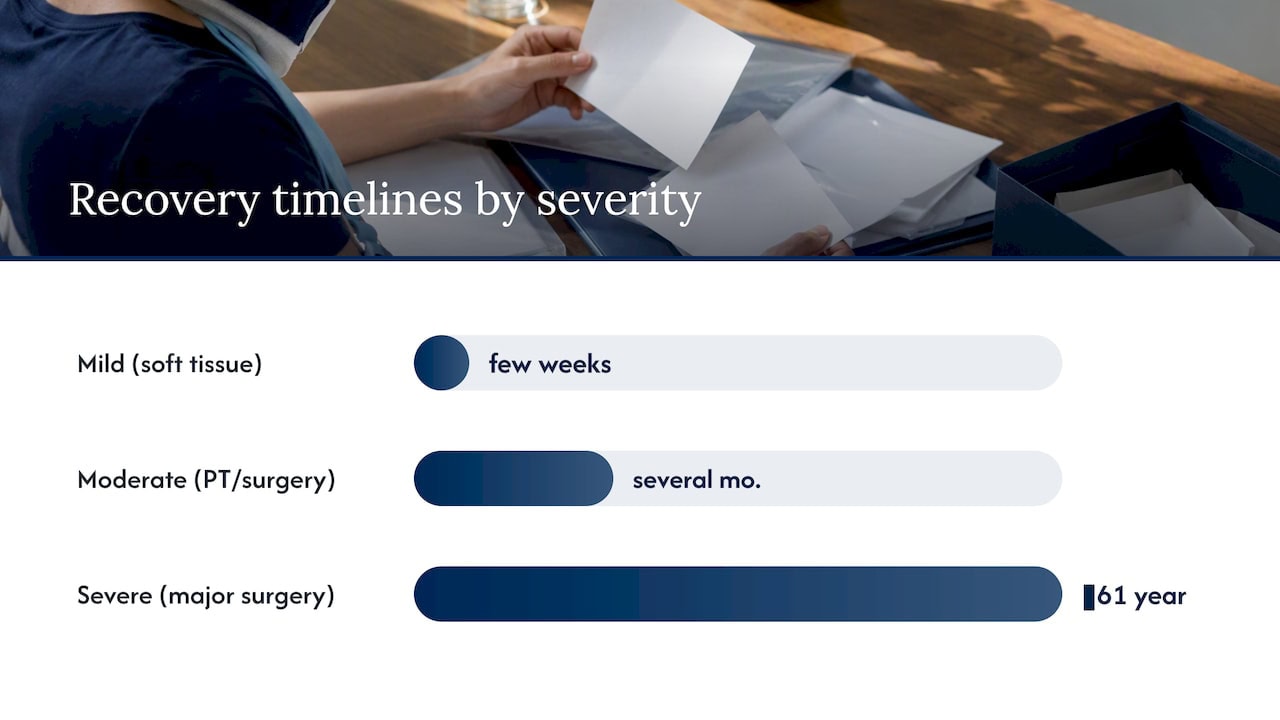
Attorneys typically wait for maximum medical improvement before finalizing a demand because it clarifies future medical needs and prevents undercompensating for care you will still need, according to guidance on preserving evidence after a crash. Mild soft tissue injuries often reach this point within a few weeks, moderate injuries requiring physical therapy or minor surgery can take several months, and severe injuries involving major surgery or long-term rehabilitation may take a year or more.
Demand, negotiation, and settlement timing (months 1 to 12+)
A demand packet, the formal document outlining your injuries, treatment, and requested compensation, is typically sent once you have reached maximum medical improvement or a clear picture of your total damages. Sending it too early risks leaving money on the table if your treatment isn’t finished.
Insurers commonly take 30 to 45 days to issue an initial response, and negotiation rounds after that can add anywhere from a few weeks to several months depending on how far apart the two sides start. A demand letter, as Cornell Law’s legal reference describes it, formally states the claim and the compensation sought, opening the negotiation phase.
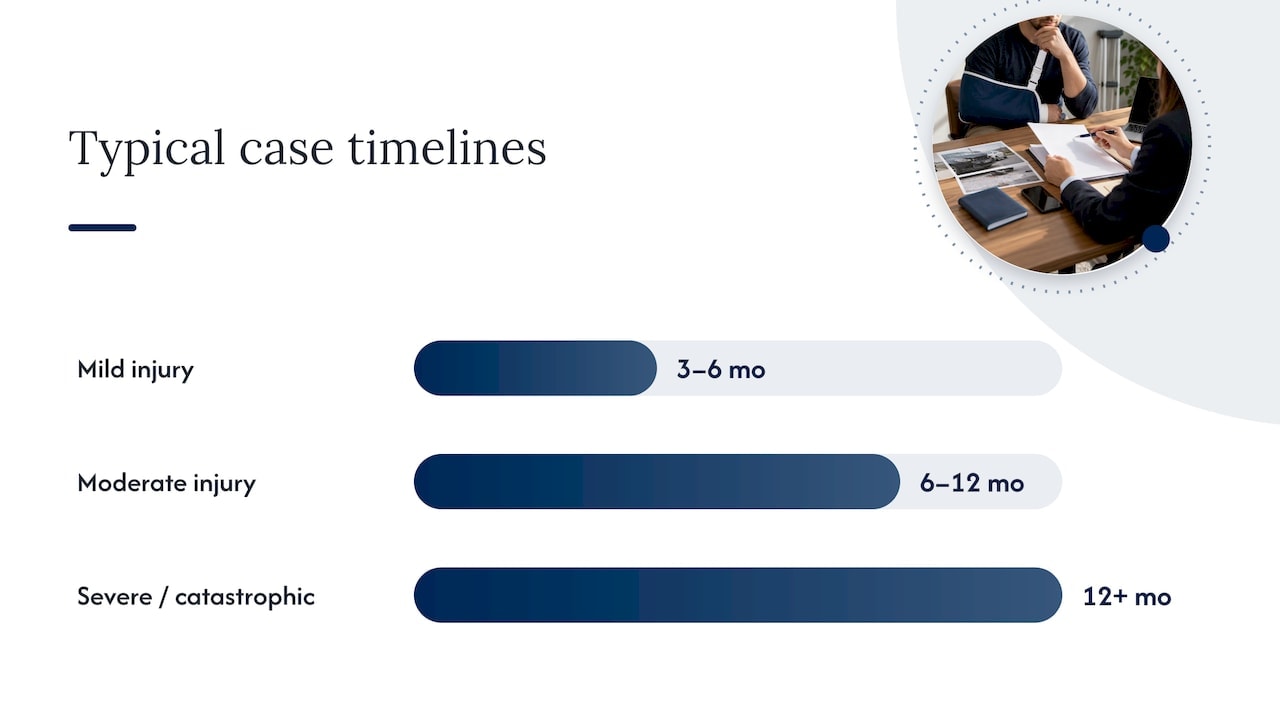
- Mild injury cases with clear liability often settle within 3 to 6 months of the crash.
- Moderate injury cases involving ongoing treatment commonly resolve in 6 to 12 months.
- Severe or catastrophic cases, especially those requiring extensive future care, often take 12 months or longer.
A complete demand, backed by full medical records and a clear liability picture, tends to move faster through negotiation than one sent with unresolved questions still hanging over it.
Filing suit and the litigation timeline (months 3 to 36+)
When negotiations stall, filing a lawsuit restarts the clock on a longer, more structured process. A settlement, as Cornell Law’s reference explains, resolves a dispute without a final court judgment, and it remains possible at nearly every stage of litigation, including the days before trial.
- Confirm your state’s statute of limitations immediately since missing it can permanently bar your claim regardless of how strong the case is.
- After filing, the defendant typically has a set window to respond, after which discovery begins.
- Discovery, the phase where both sides exchange evidence, take depositions, and retain expert witnesses, is usually the longest stretch of litigation and can run six months to two years depending on case complexity.
- Mediation or a pretrial settlement conference often follows discovery and resolves many cases before a trial date is ever set.
Most personal injury cases settle before trial, and an actual trial, while rare, can add months or years if the case proceeds that far.
Factors that speed up or slow down a case
Two cases with similar injuries can move at very different speeds depending on a handful of variables.
- Injury severity drives everything, since your case generally cannot be valued accurately until you reach maximum medical improvement.
- Clear liability, backed by video, a favorable police report, or reliable witnesses, removes one of the biggest sources of delay.
- Low policy limits, an uncooperative insurer, or multiple defendants can slow negotiations and sometimes force litigation that would otherwise be avoidable.
- Cases requiring expert witnesses, involving a government defendant, or carrying complex liens against the settlement tend to add months to the timeline.
Pro Tip: Ask your provider for a written estimate of your expected recovery timeline early on. It gives you a realistic benchmark for when a demand can reasonably be sent.
How to build a source-linked timeline and preserve evidence
A simple table, kept from day one, does more to protect a claim than memory ever will. Every entry should record the event, the date it actually occurred, the date the record was created, how precise that timing is, and how confident you are in it.
| Date of event | Event | Source | Date recorded | Confidence |
|---|---|---|---|---|
| Day of crash | Police report filed | Responding officer | Day of crash | High |
| Day of crash | Scene photos taken | Personal phone | Day of crash | High |
| Day 2 | First medical visit | Clinic intake form | Day 2 | High |
| Week 3 | Witness statement obtained | Phone call log | Week 3 | Medium |
- Never alter an original timestamp on a photo, receipt, or record; note any discrepancy instead of correcting it yourself.
- Capture surveillance footage, dashcam video, and tow records quickly since many are overwritten or discarded within days.
- Avoid repairing your vehicle before it has been photographed and, if liability is disputed, inspected.
The firm’s car accident evidence checklist walks through exactly what to capture and when.
Statutes of limitation and other deadline traps
Filing deadlines differ by state, and missing one can end a valid claim regardless of its strength. Confirm your specific deadline early rather than relying on general assumptions, since even a short delay can matter.
- Send any legally required written notice promptly, particularly for claims against a government agency, which often carry much shorter windows than standard claims.
- Consult an attorney before your deadline approaches rather than after, since some protective steps take time to complete.
- Treat administrative notice requirements for government defendants as a separate, earlier deadline from the general statute of limitations.
When you’ll receive settlement money and what affects the net amount
Once a settlement is reached, insurers typically issue payment within a few weeks, though the number on the check is rarely the number you take home. Health insurers and Medicare often hold liens against a settlement to recover what they paid for your treatment, and those amounts have to be resolved before funds are released.
- Confirm the exact lien amounts in writing before signing a release.
- Request a final payoff estimate from any lienholder so the net figure is clear.
- Read the release language carefully, since it typically closes out your right to pursue the claim further.
What a realistic timeline actually looks like
Most cases we see move faster once medical treatment stabilizes and the records are organized from the start. If evidence is at risk, a deadline is approaching, or the injuries are severe, calling a lawyer early changes what’s still recoverable.
— Adam
How 2keller can help you move your case forward
A personal injury law firm may offer a free case evaluation and contingency fee arrangement, working to secure records, preserve evidence, and manage deadlines when representing a client.

If you’re weighing your options after a crash, start with a free case evaluation to find out where your claim stands.
FAQ
How likely are you to get sued after a car accident?
Getting sued after a car accident is uncommon if you have liability insurance, since most claims are resolved directly between insurers or through a settlement rather than a lawsuit. A lawsuit typically arises only when negotiations fail or damages exceed available policy limits.
How long does it usually take to get money from a car accident?
Simple claims with clear liability and minor injuries often settle within a few months, while cases involving serious injuries or disputed fault can take a year or more. The exact timing depends heavily on when you reach maximum medical improvement and how quickly the insurer responds to a demand.
How long after a car accident can you make a claim?
The deadline to file a claim, known as the statute of limitations, differs by state and can permanently bar your case if missed. Confirming your specific state deadline early, and consulting an attorney if a government agency is involved, protects your right to pursue compensation.
Why do car accident settlements take so long?
Settlements often take time because attorneys typically wait until you reach maximum medical improvement before valuing the full extent of your damages, according to research on preserving evidence after a crash. Insurer response times, negotiation rounds, and any liens against the settlement can add further delay even after an agreement in principle is reached.