
Hire a car accident lawyer when the crash caused a serious or ongoing injury, when fault is disputed, or when an insurer delays, lowballs, or denies your claim. The same goes for wrecks involving multiple vehicles, commercial trucks, or a death. If none of that applies and damage is minor with clear fault, you can often handle the claim yourself. When any red flag shows up, talk to a lawyer before you sign anything or accept a settlement.
TL;DR:
- Significant injuries or symptoms appearing days after the crash can lead to undercompensated claims if not documented promptly.
- Evidence such as camera footage, skid marks, and witness contact info can vanish within days, requiring immediate preservation efforts.
- Disputed fault or involvement of multiple vehicles, commercial parties, or fatality increases claim complexity and the need for legal representation.
- Handling minor property damage cases independently is feasible if fault is clear, insurers cooperate, and no injuries are involved.
- Delaying legal consultation risks losing crucial evidence and missing critical deadlines, so early advice can improve claim outcomes.
Table of Contents
- Clear Signs You Should Call an Attorney Now
- How Soon to Contact a Lawyer and What to Preserve
- What a Car Accident Lawyer Does and How They Increase Recovery
- When You Can Handle the Claim Yourself
- How to Choose a Car Accident Lawyer: Criteria, Questions, and Red Flags
- Publisher Perspective and EEAT: Examples and Firm Resources
- What This Checklist Gets Right That Most Advice Misses
- How 2keller Can Help You Decide What’s Next
- Sources
Clear Signs You Should Call an Attorney Now
Some accidents resolve themselves. Others turn into a fight the moment the first insurance adjuster calls. The difference usually comes down to a handful of factors that make a claim harder to value and easier for an insurer to underpay.
Watch for these signals:
- Serious or ongoing injuries — broken bones, surgery, or symptoms that outlast a few weeks of soreness.
- Disputed or shared fault — the other driver, or their insurer, blames you for some or all of the crash.
- Insurer delays, lowball offers, or denials — the adjuster stalls, offers a number that doesn’t cover your bills, or rejects the claim outright.
- Multiple vehicles or commercial parties — a rideshare car, delivery van, or semi truck adds extra insurance layers and corporate legal teams to the mix.
- Hit-and-run or uninsured motorist — you’re now dealing with your own policy’s uninsured motorist provisions instead of a straightforward third-party claim.
- A fatality — wrongful death claims carry different legal standards and higher stakes for surviving family members.
Each of these raises the complexity of a claim because it multiplies the number of parties, policies, or medical unknowns involved. Disputed fault is a good example: under comparative fault rules, the percentage of blame assigned to you directly reduces what you can recover, so a single piece of evidence can shift a settlement by a meaningful amount.
Whiplash by the numbers: Experts note that whiplash and some neck or head injuries don’t show symptoms for days or even weeks after a crash. Accepting an early settlement typically closes the door on any later claim for those injuries, even if they turn out to be serious.
How Soon to Contact a Lawyer and What to Preserve
Every state sets a statute of limitations on personal injury claims, and the clock usually starts the day of the crash. Waiting even a few weeks to consult a lawyer can shrink your options, not because the deadline is close, but because the evidence that proves your case starts disappearing almost immediately.
Here’s what degrades fastest, and why it matters:
- Traffic and business camera footage. Many systems overwrite recordings within days. Cornell’s guidance on evidence preservation notes that footage from a nearby storefront or intersection camera can vanish before an insurer even opens a file.
- Skid marks and debris patterns. Weather, traffic, and road crews erase these within a day or two.
- Witness contact information. People scatter after a crash, and phone numbers jotted on a napkin get lost.
- Vehicle damage and scene photos. Repairs and tow trucks change the scene fast.
Do this now, before anything else:
- Get medical care, even if you feel fine. Some injuries take time to surface.
- Photograph the vehicles, the road, and any visible injuries.
- Get the police report number from the responding officer.
- Write down witness names and phone numbers on the spot.
- Decline recorded statements to the other driver’s insurer until you’ve talked to a lawyer.
Pro Tip: Insurers know evidence disappears fast, and some count on it. A lawyer can send preservation letters or subpoenas to businesses and municipalities within days of taking your case, locking down footage that would otherwise be gone in a week.
What a Car Accident Lawyer Does and How They Increase Recovery
A lawyer’s job starts well before any negotiation. Investigation work often includes:
- Pulling medical records, police reports, and vehicle damage estimates
- Coordinating accident reconstruction when fault is contested
- Subpoenaing surveillance footage or black box data before it’s erased
- Bringing in expert witnesses on injury causation or future care costs
Valuing a claim accurately is where most people underestimate what they’re owed. Future medical care, lost earning capacity, and pain and suffering are notoriously hard to price without someone who has handled similar cases and knows what juries and insurers actually pay for comparable injuries.
Negotiation leverage changes once a lawyer is involved, partly because filing suit becomes a real possibility instead of an empty threat. Most car accident lawyers work on contingency, meaning they only get paid, typically a percentage of your settlement or award, if they win your case. There’s no upfront bill and no fee if the case doesn’t succeed.
When You Can Handle the Claim Yourself
Not every fender bender needs a lawyer. The textbook case for handling it yourself involves property damage only, no injuries, fault that isn’t in dispute, and an insurer that’s cooperating without delay or pushback.
If that’s your situation, here’s how to do it right:
- Get two or three repair estimates before accepting the insurer’s number.
- Photograph the damage from multiple angles.
- Confirm the police report matches your account of events.
- Ask about a rental car allowance if your vehicle is in the shop.
- Use your policy’s appraisal clause if the insurer’s estimate seems too low.
One caution: a quick settlement offer is sometimes a sign the insurer wants to close the file before symptoms like whiplash show up. If new pain appears after you’ve accepted a check, or the insurer suddenly slows down, stop and get a legal opinion before signing anything else.
How to Choose a Car Accident Lawyer: Criteria, Questions, and Red Flags
Picking the right lawyer matters almost as much as deciding to hire one at all. Look for someone with a track record in cases similar to yours, real trial experience (not just settlements), and a fee agreement they can explain in plain language.
Bring these questions to your free consultation:
- What do you estimate this case is worth, and how did you arrive at that number?
- How long do cases like mine typically take to resolve?
- Who at your firm will actually handle my file day to day?
- Are there any costs I’d owe outside the contingency fee, win or lose?
Watch for these red flags:
- Pressure to sign a representation agreement on the spot
- Vague or shifting answers about fees
- No history of taking cases to trial
- Slow or unclear communication during the initial consult
Positive signs include a written fee agreement, documented case results, and staff who can support you in your preferred language if needed.
Bring these documents to your consultation: the police report, photos of the scene and injuries, medical records so far, pay stubs if you missed work, and any correspondence you’ve already had with the insurer.
Publisher Perspective and EEAT: Examples and Firm Resources
A personal injury law firm has represented injured clients across multiple states for many years, working on a contingency basis with free initial consultations and no fee unless the case settles or wins.
Time-sensitive evidence has changed outcomes in cases the firm has handled. A business’s security footage, secured within days through a preservation letter, has settled disputes over fault that otherwise would have come down to conflicting driver accounts. Skid marks photographed and measured before a rainstorm have done the same in reconstruction disputes.
A few practical takeaways worth acting on:
- Early counsel can mean the difference between evidence that exists and evidence that’s gone.
- Delayed symptoms, especially whiplash-related injuries, are one of the most common reasons early settlements backfire.
- Before signing any release, review what a release actually waives.
What This Checklist Gets Right That Most Advice Misses
Most articles on this topic treat “do I need a lawyer” as a binary tied to injury severity alone. That’s incomplete. The real test is a complexity-and-stakes calculation: how many parties are involved, how contested is fault, and how motivated is the insurer to lowball you before your medical picture is even clear.
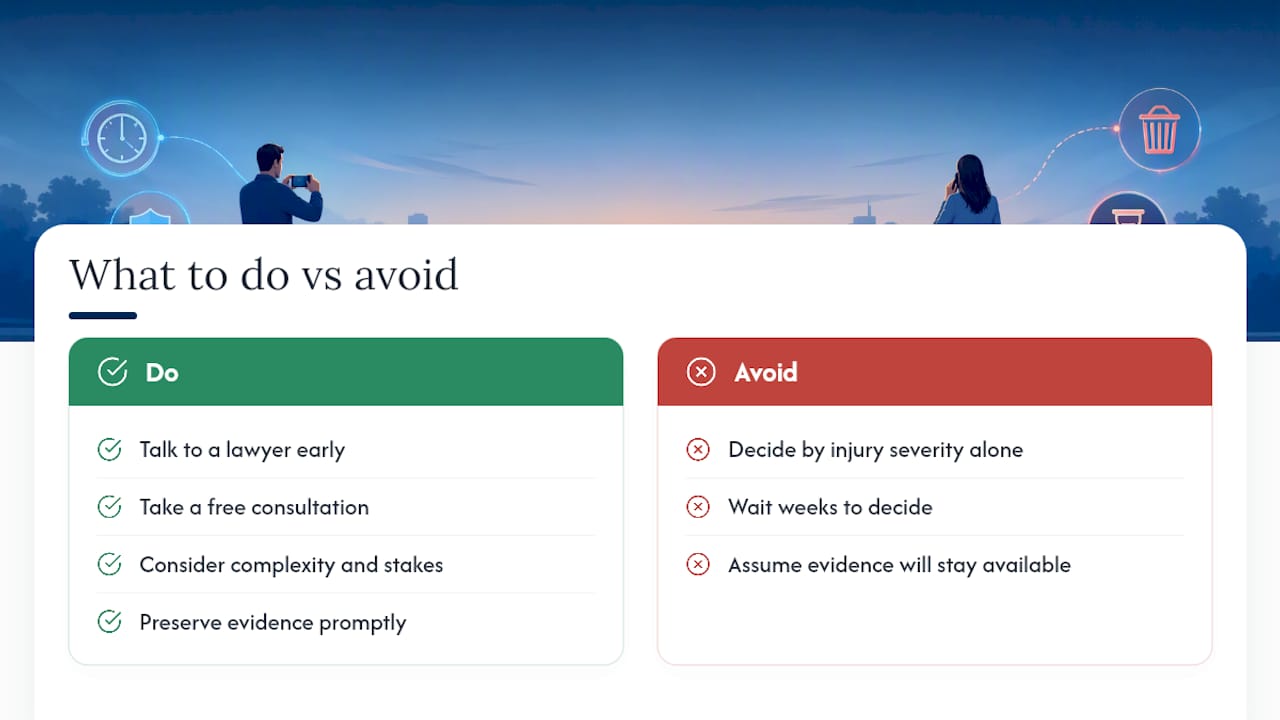
Conventional advice also underweights timing. People treat the decision to hire a lawyer as something they can revisit in a few weeks once they see how they feel. But evidence like camera footage and skid marks doesn’t wait for you to feel ready, and neither does the statute of limitations clock. By the time symptoms surface or an insurer’s first offer starts looking suspicious, the footage that would have proven fault may already be gone.
If you take one thing from this checklist, make it this: the cost of a free consultation is zero, and the cost of waiting can be evidence you never get back. Err on the side of talking to someone early, even if you end up handling the claim yourself.
— Adam
How 2keller Can Help You Decide What’s Next
Some personal injury law firms offer free consultations and work entirely on contingency, which means you owe nothing upfront and nothing at all unless your case settles or wins. That structure exists precisely for the moment you’re in right now: unsure whether your accident is serious enough to warrant a lawyer, but not wanting to risk missing evidence or a deadline while you figure it out.

During your initial consult, expect a straightforward conversation about what happened, what injuries you’re dealing with, and what the insurer has said so far. Bring your police report, photos, and any medical records you already have. If you’re not sure what to expect from that first meeting, our case evaluation guide walks through the process step by step. Start there, or reach out directly for a free consultation to find out where you stand.
This article is general information, not a substitute for advice from a qualified lawyer. Consult a qualified legal professional about your own circumstances before acting on anything here.