
A contingency fee is defined as a legal payment arrangement where your attorney collects a fee only if your case results in a financial recovery. No win means no attorney fee. This structure is the standard in personal injury and accident claims across Indiana, Michigan, New Mexico, and most of the United States. Understanding how contingency fees work, what percentages to expect, and what the written agreement actually says can mean thousands of dollars difference in your final recovery. 2keller operates entirely on this model, so every client starts with zero upfront cost.
What is a contingency fee and how does it apply to your case?
A contingency fee arrangement means your lawyer’s payment depends entirely on winning your case. If the case is lost, you owe no attorney fee. This model exists specifically to give injury victims access to experienced legal representation regardless of their financial situation.
Personal injury claims are the most common context for this arrangement. Car accidents, truck collisions, slip and fall incidents, and workplace injuries all typically qualify. The attorney takes on the financial risk of pursuing your claim, and in exchange, receives a percentage of whatever compensation you recover.

The percentage your attorney receives is not arbitrary. Fee percentages typically range from 33% to 40% of the total recovery, depending on the stage your case reaches. A case that settles early generally carries a lower percentage than one that proceeds to trial or appeal. Knowing this range before you sign anything puts you in a much stronger position.
How does a contingency fee work in practice?
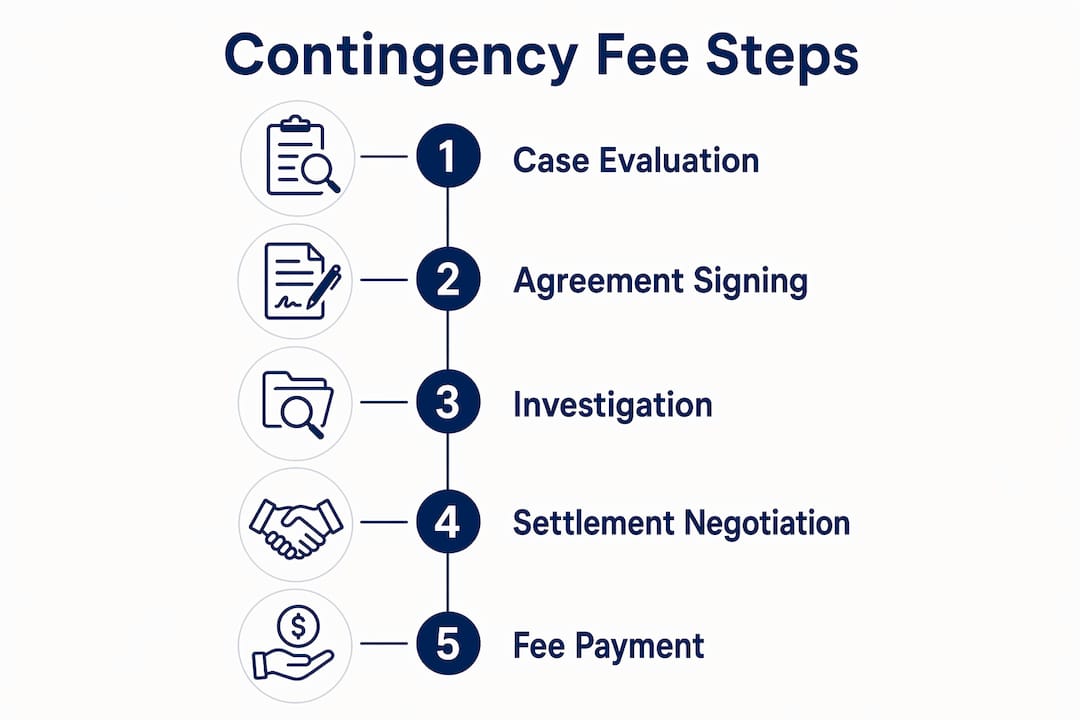
The mechanics of a contingency fee arrangement follow a clear sequence. Your attorney files your claim, conducts investigations, negotiates with insurance companies, and prepares for trial if necessary. All of that work happens before any payment changes hands.
Your lawyer also advances all litigation costs during the case, including court filing fees, expert witness fees, medical record retrieval costs, and deposition expenses. These costs are reimbursed from your settlement or award only if the case succeeds. This means you face no out-of-pocket expenses while your case is active.
Key details that shape how the arrangement works in practice:
- Fee percentage at settlement: Typically 33%, the most common rate when a case resolves before trial.
- Fee percentage at trial: Often rises to 40% because trial preparation requires significantly more attorney time and resources.
- Fee percentage on appeal: Can increase further if the case requires appellate court involvement.
- Cost advancement: The attorney covers 100% of litigation expenses upfront and recovers them only upon a successful outcome.
- No recovery, no fee: If the case is lost, you owe no attorney fee at all.
The settlement rate for personal injury cases reinforces why this model works. About 95% of personal injury cases settle before trial. That statistic means most clients pay the lower percentage rate and never face the uncertainty of a courtroom verdict.
Pro Tip: Ask your attorney at the first consultation exactly what percentage applies at each stage of your case. Get the answer in writing before you sign the fee agreement.
What are the key nuances in contingency fee agreements?
The written agreement is where the details that matter most live. Professional conduct rules require that contingency fee agreements be in writing, signed by the client, and explicitly state the fee percentage, how expenses are handled, and how the fee changes at different litigation stages. A verbal agreement is not sufficient and offers you no protection.
Gross vs. net recovery: a critical distinction
The single most financially significant detail in your agreement is whether the attorney’s fee is calculated on the gross recovery or the net recovery. This distinction is not always explained clearly, and it can cost you thousands of dollars.
| Calculation method | How it works | Client impact on a $100,000 settlement with $10,000 in expenses |
|---|---|---|
| Gross recovery (33%) | Fee calculated before expenses are deducted | Attorney receives $33,333; client receives $56,667 |
| Net recovery (33%) | Fee calculated after expenses are deducted | Attorney receives $29,700; client receives $60,300 |
The order of deductions can cause thousands of dollars difference in your final take-home amount. This is not a minor technicality. It is one of the first questions you should ask before signing.
Expense responsibility if you lose
The “no win, no fee” principle covers attorney fees only. Some agreements require clients to repay litigation expenses even if the case is lost. Other agreements absorb those costs entirely. Policies vary between law firms, and the agreement will specify which applies to you.
Litigation expenses like expert fees or court costs can become client liabilities if the case fails, unless the agreement explicitly states otherwise. Read that section of your agreement carefully. If it is unclear, ask your attorney to explain it in plain language before you sign.
Pro Tip: Request a written breakdown of all anticipated case expenses at the start of your representation. This gives you a realistic picture of your financial exposure if the case does not succeed.
What are the benefits and potential drawbacks of contingency fees?
Contingency fees exist because most injury victims cannot afford to pay an attorney by the hour while recovering from an accident. The arrangement solves a real problem, and it does so in a way that aligns your attorney’s financial interests directly with yours.
Benefits of contingency fee representation:
- No upfront cost. You pay nothing to start your case. This removes the financial barrier that would otherwise prevent many injury victims from seeking legal help.
- Risk transfer. Your attorney absorbs the financial risk of pursuing your claim. If the case fails, the attorney loses the time and money invested.
- Aligned incentives. Attorneys earn only when clients win, which motivates them to pursue the highest possible settlement rather than settling early for a lower amount.
- Access to experienced counsel. Contingency arrangements give you access to attorneys who handle complex litigation that you could not otherwise afford.
Potential drawbacks to understand:
- Higher percentage at trial. If your case goes to trial, the fee percentage rises. A 33% settlement rate can become 40% at verdict.
- Expense risk on loss. Depending on your agreement, you may owe case expenses even if you lose.
- Percentage on large recoveries. On very large settlements, the attorney’s share is proportionally large, even if the work required was not proportionally greater.
Comparing contingency fees to hourly billing clarifies the trade-off. Hourly rates for experienced personal injury attorneys can reach several hundred dollars per hour. A complex case requiring 200 hours of attorney time at $400 per hour costs $80,000 regardless of outcome. The contingency model eliminates that risk entirely for the client.
How to protect yourself when reviewing a contingency fee agreement
Reading a fee agreement carefully before signing is the single most protective step you can take. The agreement is a contract, and its terms govern your financial relationship with your attorney for the entire life of your case.
- Get everything in writing. Written agreements are legally required and must include the exact percentage, expense terms, and any fee changes at different case stages. Never proceed without a signed written agreement.
- Ask whether the fee is gross or net. Confirm whether the percentage applies before or after expenses are deducted from your recovery. The difference can be substantial, as the table above illustrates.
- Clarify expense responsibility on a loss. Ask directly: “If we lose, do I owe anything for case expenses?” Get the answer reflected in the written agreement.
- Negotiate the percentage if you have prepared your case. Clients who have gathered evidence, organized medical records, or initiated insurance claims reduce the attorney’s early investigatory workload. That preparation can support a request for a lower fee percentage.
- Confirm the scope of legal services. The agreement should specify exactly what legal work is covered, including whether appeals are included or require a separate arrangement.
- Use your initial consultation fully. Initial consultations are the right time to ask about expense handling, fee basis, and any other financial terms. Attorneys expect these questions and a good attorney welcomes them.
The California Bar’s guidance on fees reinforces that clients who ask clear questions about fee basis and expense handling before signing are far better protected than those who sign without reviewing the terms. That principle applies in every state.
Key Takeaways
A contingency fee arrangement gives injury victims access to experienced legal representation with no upfront cost, but the written agreement’s specific terms on fee percentage, expense handling, and calculation method determine your actual financial outcome.
| Point | Details |
|---|---|
| No win, no fee | You owe no attorney fee if your case is lost, but expense responsibility varies by agreement. |
| Fee percentage range | Contingency fees typically range from 33% at settlement to 40% at trial. |
| Gross vs. net calculation | Whether fees are calculated before or after expenses can change your recovery by thousands of dollars. |
| Written agreement required | Professional conduct rules require a signed written agreement detailing all fee terms before representation begins. |
| Negotiation is possible | Clients who arrive with organized evidence and documentation can negotiate a lower fee percentage. |
What I’ve learned from watching clients sign without reading
After years of working alongside injury claimants, the pattern I see most often is this: clients focus entirely on whether they have a case and almost nothing on the financial terms of their representation. That is understandable. You are dealing with pain, medical bills, and uncertainty. The last thing you want to think about is contract language.
But the gross versus net distinction alone can shift thousands of dollars from your pocket to your attorney’s. I have seen clients genuinely surprised at their final check because they did not realize the fee came off the top before expenses were subtracted. That surprise is entirely avoidable.
The other thing clients consistently underestimate is their negotiating position. If you have already gathered your medical records, filed an insurance claim, and documented your damages, you have done real work that reduces what your attorney needs to do at the start. That is leverage. Use it before you sign, not after.
Contingency fees are a genuinely fair arrangement when the terms are transparent. They give you access to legal firepower you could not otherwise afford, and they put your attorney’s financial interests squarely on your side. The key is knowing what you are agreeing to. Read the agreement. Ask the questions. A trustworthy attorney will answer every one of them clearly.
— Adam
Personal injury representation with transparent fee terms at 2keller
2keller represents personal injury clients in Indiana, Michigan, and New Mexico on a contingency fee basis. That means you pay nothing upfront and owe no attorney fee unless your case results in a recovery.

The team at 2keller explains fee terms clearly before any agreement is signed, including how expenses are handled, what percentage applies at each case stage, and what your financial obligations are if the case does not succeed. If you have been injured in an accident and want to understand your legal representation options, a case evaluation costs you nothing. You can also learn more about the zero fee guarantee and what it means for your case before making any decisions.
FAQ
What does a contingency fee mean for a personal injury client?
A contingency fee means your attorney collects a fee only if your case results in a financial recovery. If the case is lost, you owe no attorney fee.
What percentage does a contingency fee attorney typically charge?
Contingency fees typically range from 33% to 40% of the total recovery, with lower percentages applying to cases that settle before trial and higher percentages applying to cases that go to verdict.
What is the difference between gross and net contingency fee calculations?
A gross fee is calculated on the full settlement amount before expenses are deducted. A net fee is calculated after expenses are subtracted. On a $100,000 settlement with $10,000 in expenses, the difference can be more than $3,000 in your final recovery.
Do I owe anything if my personal injury case is lost?
You owe no attorney fee if your case is lost. However, some agreements require clients to repay litigation expenses regardless of outcome. Confirm this in writing before signing your fee agreement.
Can I negotiate my contingency fee percentage?
Yes. Clients who have already gathered evidence, organized medical records, or initiated insurance claims can sometimes negotiate a lower percentage, because their preparation reduces the attorney’s early workload.