
Slip and fall injury damages are the monetary compensation awarded when you suffer injuries due to unsafe property conditions, covering medical expenses, lost wages, and pain and suffering. Understanding these damages is the first step toward recovering what you are legally owed. Premises liability law, which governs these claims in states like Indiana, Michigan, and New Mexico, places a duty of care on property owners to maintain safe conditions. When they fail that duty and you get hurt, the law provides a path to compensation. This guide breaks down every category of slip fall injury damages explained in plain terms, so you know exactly what to pursue.
What are slip fall injury damages and how are they defined?
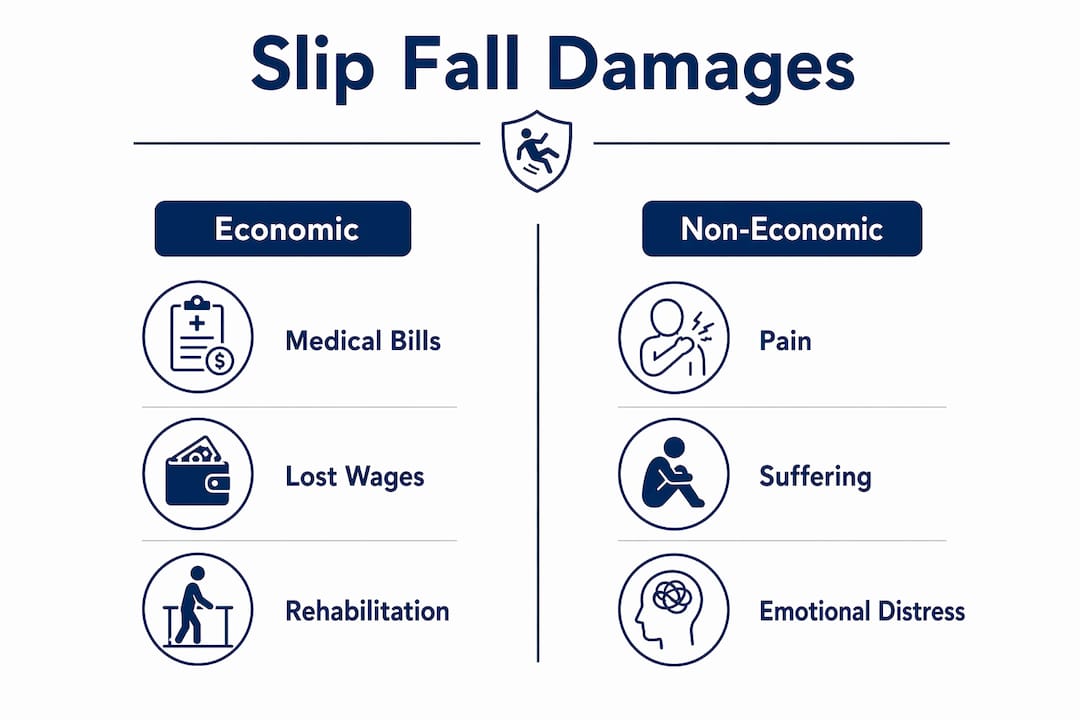
Slip and fall damages fall into two primary categories: economic and non-economic. Economic damages are the measurable financial losses you can document with bills and pay stubs. Non-economic damages cover the physical pain, emotional distress, and reduced quality of life that do not come with a receipt.
Economic damages typically include emergency room bills, surgery costs, physical therapy, prescription medications, and any future medical care your injuries require. Lost wages cover the income you missed while recovering, and lost earning capacity covers what you may never earn again if your injuries are permanent. Non-economic damages, often called pain and suffering, are harder to quantify but are just as real and legally recoverable.

The distinction between a slip and a trip also matters legally. A slip involves loss of traction on a surface, while a trip involves an obstacle that catches your foot. The legal standard for the property owner’s duty to remedy the hazard differs between the two, which affects how liability is established in your claim.
How are slip and fall damages calculated?
Economic damages are calculated by adding up every documented financial loss. That means every medical bill, every missed paycheck, and every projected future treatment cost. Your attorney will work with your doctors to estimate the full cost of future care, which is often the largest single component in serious injury claims.
Non-economic damages use a method called the multiplier approach. Insurance companies and attorneys apply a multiplier of 1.5 to 5 times the total economic damages to estimate pain and suffering. A higher multiplier applies when injuries are severe, permanent, or significantly disrupt your daily life.
Settlement ranges vary widely by injury severity:
| Injury severity | Typical settlement range |
|---|---|
| Minor (sprains, bruises) | $10,000–$50,000 |
| Moderate (fractures, soft tissue) | $45,000–$250,000 |
| Severe (surgery required) | $125,000–$1,000,000 |
| Catastrophic (permanent disability) | $400,000 and above |
These figures reflect real outcomes. Settlement amounts range from approximately $15,000 for minor injuries to over $400,000 for catastrophic permanent disability cases. Regional factors also apply: in California, catastrophic injury claims regularly exceed $1,000,000 when evidence is strong and liability is clear.
Pro Tip: Document every out-of-pocket expense from day one, including mileage to medical appointments, over-the-counter medications, and home care costs. These small amounts add up and belong in your economic damages total.
What factors influence slip and fall compensation?
Several variables determine how much your claim is ultimately worth. Injury severity is the most significant factor. A fractured hip requiring surgery and months of rehabilitation produces far greater damages than a sprained ankle treated with rest and ice.
The property owner’s degree of negligence also matters. Courts and insurers look at whether the owner knew about the hazard, how long it existed, and whether they took any steps to fix it or warn visitors. A wet floor with no warning sign that has been reported to management three times is a much stronger liability case than a hazard that appeared minutes before your fall.
Comparative fault rules can reduce or eliminate your recovery. If you are found partially responsible for your fall, your compensation decreases by your percentage of fault. Comparative fault rules work this way: a 20% fault finding on a $100,000 claim reduces your recovery to $80,000. Texas bars any recovery if your fault exceeds 51%. Indiana and Michigan follow modified comparative fault rules with similar thresholds.
The type of property also shapes your claim. Government-owned properties carry strict notice requirements. Notice deadlines for government properties can be as short as 30–90 days. Missing that window can bar your claim entirely, regardless of how clear the liability is.
Insurance adjusters commonly dispute medical record gaps or raise partial fault arguments to minimize settlement values. Thorough documentation and legal counsel are the most effective counters to these tactics. Every gap in your treatment history gives an adjuster a reason to argue your injuries were not as serious as claimed.
Pro Tip: Never give a recorded statement to an insurance adjuster without speaking to an attorney first. Adjusters are trained to ask questions that produce answers they can use to reduce your payout.
Additional factors that affect your final compensation include:
- The quality and consistency of your medical treatment records
- Whether expert witnesses can testify about your injury’s long-term impact
- Prior incident history at the same location, which establishes the owner’s notice of the hazard
- Whether you followed all prescribed medical treatment without gaps
How do you prove fall injury liability and damages?
Proving a slip and fall claim requires connecting four elements: the property owner owed you a duty of care, they breached that duty, the breach caused your fall, and the fall caused your injuries. Each link in that chain needs evidence.
Follow these steps to build a strong case:
- Report the incident immediately. Notify the property owner or manager and get a written incident report. This creates an official record with a timestamp.
- Photograph everything. Capture the hazard, the surrounding area, any warning signs (or their absence), your injuries, and your footwear. Take photos before anything is cleaned up or repaired.
- Seek medical care the same day. A gap between your fall and your first medical visit gives insurers room to argue your injuries came from something else. Consistent medical documentation directly strengthens claim value.
- Collect witness information. Names and contact details from anyone who saw the fall or knew about the hazard beforehand are valuable.
- Request surveillance footage. Many properties have cameras. Footage can be overwritten quickly, so your attorney should send a preservation letter as soon as possible.
- Obtain prior incident records. If others fell at the same location, those records help prove the owner had notice of the hazard.
Medical professionals’ documentation and expert testimony are critical to ensuring the full extent of your injuries, including future treatment needs, is recognized in your claim. Do not skip follow-up appointments. Every missed visit creates a gap that insurers will exploit.
Pro Tip: If your fall happened on government property, contact a personal injury attorney within days, not weeks. Notice deadlines as short as 30–90 days apply in many jurisdictions, and missing them ends your claim permanently.
What types of fall injury claims exist and how do damages vary?
Fall injury claims are not one-size-fits-all. The type of injury you sustain determines the treatment path, the recovery timeline, and the damages you can claim.
Minor injuries include sprains, bruises, and minor cuts. These typically resolve within weeks with rest, physical therapy, and over-the-counter pain relief. Settlement values for minor injuries generally fall in the $10,000–$50,000 range, depending on documentation quality and any lost wages.
Moderate injuries include bone fractures, torn ligaments, and significant soft tissue damage. These require imaging, specialist visits, and sometimes casting or bracing. Recovery can take months, and future arthritis or chronic pain is common. Settlements in this category often reach $45,000–$250,000.
Severe injuries involve surgical intervention. Hip fractures, spinal injuries, and serious knee damage requiring replacement or reconstruction fall here. Recovery spans months to years, and permanent limitations are frequent. These claims regularly settle in the $125,000–$1,000,000 range.
Catastrophic injuries include traumatic brain injuries, spinal cord damage causing paralysis, and injuries resulting in permanent disability. These claims account for lifetime medical costs, lost earning capacity, and the full weight of non-economic damages. Catastrophic cases settle at $400,000 and above, with no upper ceiling when evidence is strong.
No two claims settle for the same amount. Settlement values depend heavily on the strength of evidence and how clearly the injury connects to the property owner’s negligence. A well-documented moderate fracture can outperform a poorly documented severe injury in settlement negotiations.
Key variables that shift damages within each category:
- Age and pre-existing conditions of the injured person
- Permanence of the injury and its effect on daily activities
- Strength of liability evidence against the property owner
- Jurisdiction and applicable state law
Key Takeaways
Slip and fall compensation depends on injury severity, documented evidence, and the property owner’s degree of negligence, with legal representation consistently producing the highest outcomes.
| Point | Details |
|---|---|
| Two damage categories | Economic damages cover bills and lost wages; non-economic covers pain and suffering. |
| Multiplier method | Insurers calculate pain and suffering at 1.5–5 times your total economic damages. |
| Comparative fault reduces recovery | A 20% fault finding on a $100,000 claim cuts your payout to $80,000. |
| Government property deadlines | Notice requirements can be as short as 30–90 days; missing them bars your claim. |
| Documentation drives value | Consistent medical records and preserved evidence directly increase settlement amounts. |
What I have learned from years of slip and fall claims
After working closely with injury victims across Indiana, Michigan, and New Mexico, the pattern I see most often is this: people underestimate their claim in the early days and overestimate how forgiving the process will be if they wait.
The single biggest mistake I see is delayed medical care. Victims feel embarrassed, or they assume the pain will pass. Two weeks later, the insurance adjuster points to that gap and argues the injury was minor or unrelated to the fall. That argument costs real money.
The second mistake is talking to insurers without counsel. Adjusters are not on your side. They are trained to gather information that reduces the company’s payout. A recorded statement given without legal guidance can permanently damage your claim’s value.
Victims with attorneys receive on average 3.5 times higher settlements than those without representation. That number reflects the difference between knowing how to document, negotiate, and counter insurer tactics versus learning those lessons the hard way during your own claim.
My honest advice: treat your claim like a legal case from the moment you fall, not after you have already made mistakes. Get medical care, preserve evidence, and speak with an attorney before you speak with anyone from the insurance company.
— Adam
How 2keller can help with your slip and fall claim
If you are dealing with a slip and fall injury in Indiana, Michigan, or New Mexico, 2keller’s personal injury attorneys have the experience to build your case from the ground up.

The 2keller team gathers evidence, works with medical professionals to document the full scope of your injuries, and negotiates directly with insurance companies to counter the tactics that reduce settlements. From minor fractures to catastrophic injuries, 2keller handles claims at every level of severity. The consultation is free, and you pay nothing unless we win your case. Reach out to 2keller today to get a clear picture of what your claim is worth.
FAQ
What is the average slip and fall settlement amount?
Settlement amounts range from approximately $15,000 for minor injuries to over $400,000 for catastrophic permanent disability cases. The final amount depends on injury severity, liability strength, and the quality of your documentation.
How does comparative fault affect my slip and fall compensation?
If you are found partially at fault, your compensation decreases by your fault percentage. In Texas, fault above 51% bars any recovery entirely, and similar modified comparative fault rules apply in Indiana and Michigan.
How long do I have to file a slip and fall claim on government property?
Government property claims require notice filing within as little as 30–90 days in many jurisdictions. Missing this deadline can permanently bar your claim regardless of how clear the liability is.
Does hiring an attorney really make a difference in my settlement?
Victims represented by attorneys receive on average 3.5 times higher settlements than those without legal representation. Attorneys know how to document injuries, counter insurer tactics, and negotiate from a position of strength.
What evidence do I need to prove a slip and fall claim?
You need photos of the hazard, an incident report, consistent medical records, witness statements, and any available surveillance footage. Gaps in medical treatment or missing documentation are the most common reasons claims lose value.