

New Mexico Car Accident Lawyers
Keller & Keller Injury Lawyers’ Winning Approach
Free Case EvaluationInjured in a Car Accident?
Get started with a free case evaluation. No Fee Until We Win.
100% Free Evaluation
Provide a few details and our team will handle the rest.
"*" indicates required fields

“As a busy mom of three, I’m so grateful I didn’t have to face the legal battle alone. Thank you, Keller & Keller Injury Lawyers.”
Kelly


When you’ve been injured in a car accident, you need more than just legal representation. You need a battle-tested sword and shield fighting for your rights.
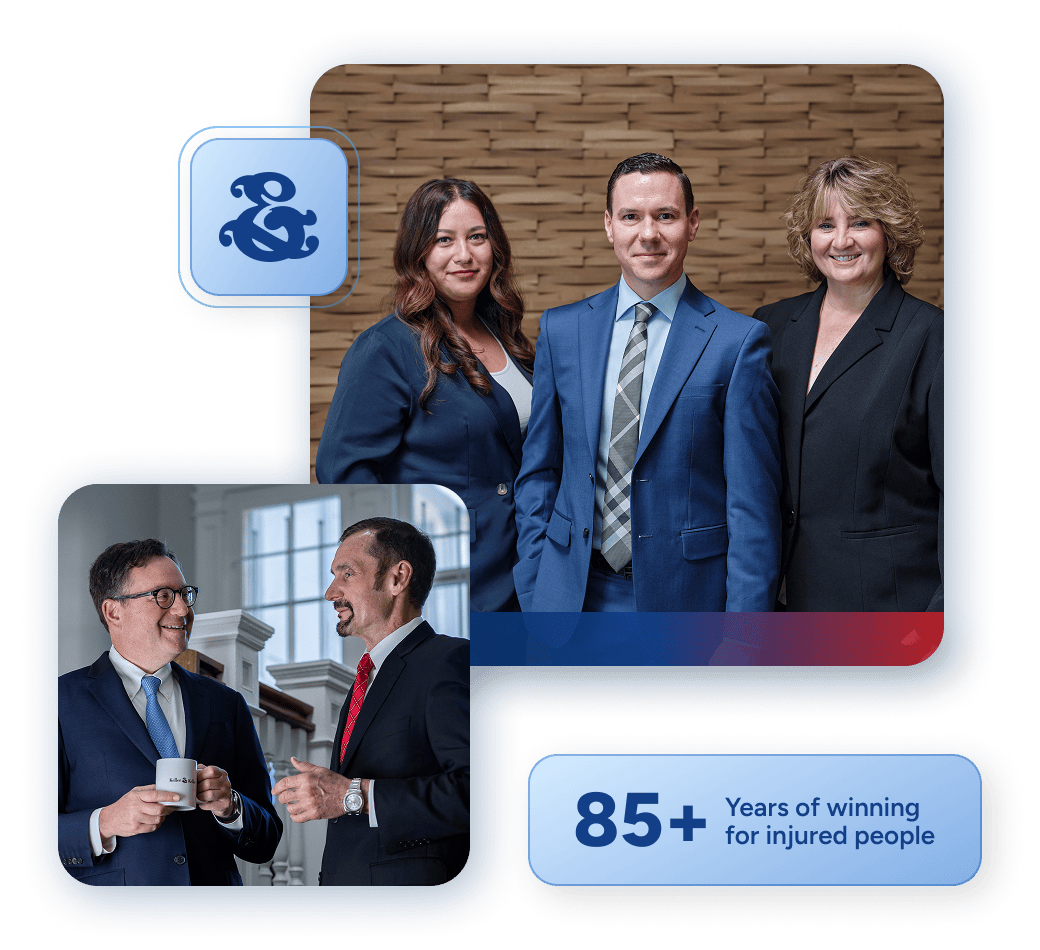
Keller & Keller has been maximizing client settlements and delivering justice since 1936, establishing our firm as one of the nation’s leading personal injury law firms. From our office in the Uptown neighborhood of Albuquerque, our car accident attorneys serve clients throughout New Mexico with a commitment to excellence that has earned us recognition as Super Lawyers for over 10 consecutive years. With decades of experience navigating complex car accident claims in New Mexico, we’ve recovered millions of dollars for our clients, proving that results matter.
Why You Need a Car Accident Lawyer After a Crash
The aftermath of a car accident can turn your life upside down in an instant. Medical bills pile up, insurance companies pressure you to accept lowball offers, and you’re left wondering how to put your life back together while still recovering from your injuries. This is when having an experienced car accident lawyer becomes crucial.

Navigating Complex Legal Claims

Understanding Insurance Company Tactics

Understanding Statute of Limitations
Navigating Complex
Legal Claims
Car accident claims involve complicated legal processes that most people aren’t equipped to handle on their own. Determining fault, establishing negligence, calculating long-term damages, and interpreting insurance policies requires specialized knowledge. Without proper legal representation, you risk making costly mistakes that could reduce your compensation or even result in your claim being denied entirely.

Understanding Insurance Company Tactics
Insurance companies operate as businesses with financial objectives that may not align with your recovery needs. Their adjusters use tactics like pressuring you for recorded statements, offering quick settlements before you understand the full extent of your injuries, and disputing the severity of your damages. At Keller & Keller, we’ve seen every insurance company trick and know how to protect your interests.

Understanding Statute of Limitations
In New Mexico, the statute of limitations for personal injury claims is generally three years from the date of the accident. Missing this deadline typically means permanently losing your right to seek compensation, so contacting an attorney promptly is essential.

What to Do After a Car Accident in New Mexico
Taking the right steps after a crash can protect both your health and your legal claim.
See What Your Case Is WorthMove to a safe location away from traffic and check for injuries.
Immediately file an official police report, even for minor accidents.
See a doctor right away, as adrenaline can mask serious injuries.
Take photos & videos of injuries, vehicles, the scene, skid marks, road hazard, and collect witness information.
Collect contact and insurance details from all drivers and parties involved: drivers, passengers, and witnesses.
Notify your insurance company about the accident.
Save all medical bills, repair estimates, and accident-related documents.
Politely decline insurance adjuster requests for comment.
Refrain from posting your accident on social accounts.
Early legal representation helps preserve evidence, meet deadlines, and prevent costly mistakes while dealing with insurance companies.

The Keller & Keller Injury Lawyers Approach:
New Mexico Injury Lawyers Who Fight to Win
From the moment you contact us, you’ll notice the difference in our approach. Our client-first philosophy means we take the time to understand not just the details of your accident but how it has affected your life, your work, your family, and your future in New Mexico. We clearly communicate every step of the process in plain language you can understand, no confusing legal jargon. This approach has earned us countless 5-star reviews from real New Mexico clients who’ve experienced the Keller & Keller difference firsthand.
We understand that being injured in an accident is stressful enough without having to chase down your lawyer for updates. That’s why we’ve built our practice around transparent, consistent communication.
When you hire us, you’ll have direct access to the New Mexico-based attorney handling your case as well as a dedicated paralegal who monitors its daily status. We keep you informed throughout every stage of your claim, explaining what’s happening, what to expect next, and how it affects your case.
Our 90+ years of experience isn’t just about longevity. It’s about results. Our attorneys have successfully handled thousands of cases in New Mexico and recovered millions and millions of dollars for our clients. We’ve gone toe-to-toe with the biggest insurance companies and won. Our courtroom experience means we’re always prepared to take your case to trial if that’s what it takes to secure fair compensation. This willingness to fight, and our track record of success, often motivates insurance companies to offer better settlements to avoid facing us in court.
The Car Accident Claim Process with Keller & Keller Injury Lawyers
When you choose our firm to handle your New Mexico car accident claim, you can expect a clear, structured process designed to maximize your compensation while minimizing your stress.
Types of Car Accidents We Handle
Our extensive experience covers all types of car accidents, each with unique challenges and considerations.
A head-on collision happens when the fronts of two vehicles meet, usually because one of them has left its lane. These crashes can be devastating on New Mexico roadways, and they often result in severe injuries or fatalities. They also tend to involve complex liability issues and substantial damages.
How Does a Car End Up in the Oncoming Lane?
On a two-lane road such as US 285, a failed pass or a slow drift across the center line may leave an oncoming driver with nowhere to go. Wrong-way entries on divided highways like I-25 and I-40 are another pattern, and impairment or fatigue may be part of the story. New Mexico law requires a vehicle to stay as nearly as practicable within one lane, and a driver can’t move out of it until first making sure the move is safe (NMSA 1978 § 66-7-317).
Fault can look obvious when one car is on the wrong side of the road, but the reason it got there still matters. A blown tire, a swerve around debris, or a third vehicle forcing a car across the line may change the picture. Our post on why head-on collisions in New Mexico are so often fatal walks through common scenarios. Gouge marks, debris and final resting positions can help show where each vehicle was at impact.
When Alcohol or Recklessness Is Part of the Crash
Alcohol can raise questions that reach beyond the driver. A licensed seller may face civil liability for serving someone who was intoxicated, but only if the intoxication was reasonably apparent and the licensee knew it from the circumstances (NMSA 1978 § 41-11-1). A social host generally isn’t liable for a guest’s intoxication unless the alcohol was provided recklessly in disregard of the rights of others.
Punitive damages are a separate question. They require a culpable mental state along with conduct that is willful, wanton, malicious, reckless, oppressive or fraudulent, and they exist to punish rather than compensate. Whether a particular driver’s conduct meets that standard depends on the facts.
What If the Losses Are Bigger Than the Policy?
A catastrophic injury can outrun a small policy quickly. New Mexico’s minimum limits are $25,000 per person and $50,000 per accident for bodily injury (NMSA 1978 § 66-5-208). When the other driver’s limits fall short, your own underinsured motorist coverage may come into play. A driver generally counts as underinsured when the available liability limits are below your own uninsured motorist limits, and that coverage is offset against the other driver’s limits rather than added on top of them.
An insurer may also bring up seat belts. Under New Mexico law, not wearing one can’t be treated as fault or negligence and can’t reduce damages (NMSA 1978 § 66-7-373). When a head-on crash takes a life, the claim generally falls under New Mexico wrongful death law, where a personal representative brings the case and a jury may weigh what the survivors lost.
A rear-end collision can push one vehicle into another, creating questions about which impact happened first. On a busy stretch of I-25 or I-40 in Albuquerque, three cars can be involved in a single moment of stopped traffic. Sorting out who hit whom, and in what order, often decides who is responsible for your injuries.
An investigation should distinguish an independent forward collision from an impact caused by being pushed from behind. In plain terms, that means working out whether the middle driver ran into the car ahead on their own, or was shoved into it by the vehicle behind. The answer may change who is legally responsible and how an insurance company values your claim.
Why the Order of Impacts Matters
Many people assume the driver at the back is always the one at fault. That is a common starting point for insurers, but it is not a rule without exceptions. New Mexico drivers may not follow more closely than is reasonable and prudent (NMSA 1978 § 66-7-318), yet depending on the facts, a sudden stop, a mechanical failure, or a second driver may change the picture.
New Mexico follows pure comparative fault (Scott v. Rizzo, 1981-NMSC-021). You can generally recover even if you were partly at fault, but your compensation is reduced by your percentage of fault. If an insurer can argue that your car struck the one in front before you were hit, it may try to shift blame onto you and lower what it offers. Our guide to New Mexico car accident comparative negligence rules explains how that argument tends to work.
Common Chain-Reaction Scenarios
- Pushed into the car ahead. A driver behind you hits your vehicle hard enough to drive it forward into the next one. In this case, your impact with the front vehicle may be a result of the first collision, not a separate mistake on your part.
- Two separate collisions. You may have bumped the car ahead before you were hit from behind. The damage you suffered may then come from two impacts with different causes.
- Multiple vehicles in a line. On a crowded road, several cars may be hit in sequence. Each driver’s share of responsibility may depend on speed, following distance, and the time between impacts.
- A sudden or unexpected stop. Traffic that stops quickly at a city intersection or a freeway merge can catch drivers off guard. The reason for the stop may matter as much as the crash itself.
- A commercial vehicle in the chain. If a truck is involved, the driver, the carrier, or other companies may share responsibility, which is common ground in a New Mexico semi-truck accident. These cases often call for early evidence requests.
What the Evidence May Show
The physical clues often tell the story better than memory does. Damage on the front and rear of each vehicle can show the direction and force of each impact. A rear bumper pushed in and a front bumper with lighter damage may suggest a different sequence than the one an insurer describes.
Many modern vehicles also carry an Event Data Recorder (EDR), sometimes called a black box. It may store speed, braking, and other data from the seconds around a crash. That data can be overwritten if a vehicle is driven, repaired, or sold, so a preservation letter and a prompt inspection may matter.
T-bone collisions, also called side-impact or broadside crashes, happen when the front of one vehicle strikes the side of another. They most often occur at intersections, where one driver fails to stop or yield and the other has no time to react. These crashes can leave drivers and passengers with serious injuries, and the legal questions afterward are rarely simple.
Why Side-Impact Crashes Can Be So Dangerous
The side of a car has far less protection than the front or rear. There is often only a door panel and a few inches of space between you and the other vehicle. In plain terms, that means the force of the impact can reach your body more directly than in many other crashes.
Injuries from T-bone crashes may include head and brain injuries, broken ribs, chest and abdominal trauma, pelvic fractures, and spinal injuries. The seat you were sitting in can matter too. The occupant on the struck side generally faces the greatest risk, but everyone in the vehicle can be hurt.
Where and How T-Bone Crashes Happen in New Mexico
Intersections are the usual setting. In Albuquerque, that can mean a busy signal-controlled crossing along a major city street, or the ramps and frontage roads near I-25 and I-40. Rural New Mexico crashes happen too, such as at a stop-controlled crossing on a highway where a driver misjudges the speed of oncoming traffic.
The causes tend to be familiar ones. Each of them may point to a driver who failed to use reasonable care:
- Running a red light or stop sign. A driver who enters an intersection against the signal can strike a vehicle that had the right of way.
- Failure to yield. Misjudging the gap in traffic is a common cause, especially at uncontrolled or poorly marked crossings.
- Distracted driving. A driver looking at a phone or a screen may never see the cross traffic until it is too late.
- Impaired driving. Alcohol, drugs, or fatigue can slow reaction time and weaken judgment at the exact moment it is needed.
- Blocked sightlines. Parked vehicles, large trucks, landscaping, or glare from the low sun can hide approaching traffic.
Who Is at Fault in a T-Bone Accident?
Fault in an intersection crash is often disputed. Each driver may say they had a green light, and there may be no independent witness. New Mexico’s comparative negligence rule means you may still recover if you were partly at fault, though your award is generally reduced by your percentage of responsibility.
Because of this rule, the other side’s insurer may try to shift part of the blame onto you. Evidence matters a great deal in that dispute. Photos, witness accounts, traffic signal timing, nearby security or traffic camera footage, and vehicle damage patterns can all help show what happened.
Claims against a city, county, or state entity can fall under the New Mexico Tort Claims Act, which generally sets a much shorter notice requirement than the time allowed for an ordinary injury claim (see NMSA 1978 § 41-4-16). If a commercial truck struck you, see our New Mexico semi-truck accident page.
Read more about T-bone and side-impact accidents in New Mexico →
A multi-vehicle accident is a crash involving three or more vehicles, and a large pileup can involve several distinct collisions. Understanding an injured person’s claim requires identifying what happened to their vehicle within the larger incident. The size of the event doesn’t answer who is responsible for your particular injuries.
One Pileup, Several Separate Crashes
Pileups on I-40 or I-25 rarely happen all at once. A first collision may block a lane, drivers behind it brake hard or swerve, and later vehicles arrive over the next seconds or minutes. A car that stopped safely may then be struck by someone who came along well after the first impact.
That timing shapes the claim, because an injury from a third hit may have nothing to do with the driver who started things. Several sources can help rebuild the sequence:
- Scene diagrams. A crash report may sketch where each vehicle stopped, which can suggest who reached whom.
- Occupant memory. Drivers and passengers may recall how many impacts they felt and how far apart they were.
- Paint and crush patterns. Marks on one vehicle can sometimes be matched to another.
- Dash camera and phone video. Footage may catch later impacts that nobody at the front of the line saw.
- Call times. Time stamps on 911 calls can help place events in order.
How Is Fault Divided Among Several Drivers?
In most New Mexico negligence cases, each defendant generally pays only the share of damages matching its own percentage of fault (NMSA 1978 § 41-3A-1). Fault can also be assigned to people who are not parties to the lawsuit. Put simply, if part of the blame lands on a driver who was never sued, that share may not be collectible from the others.
So a claim usually can’t stop at the most obvious driver. Joint and several liability, where one party can answer for more than its own share, survives only in limited situations. Those include parties who are vicariously liable for one another, meaning legally answerable for someone else’s conduct. Our article on compensation after a multi-vehicle crash in New Mexico looks at how these cases tend to unfold.
When Several People Look to the Same Insurance Policy
A serious pileup can leave more than one injured person looking to a single policy. New Mexico’s minimum bodily injury limits are $25,000 for one person and $50,000 per accident, so a minimum policy may be spread thin when several people are hurt. Our explainer on when $25,000 caps a New Mexico car accident settlement shows why those limits often become the first practical problem.
With more than one driver at fault, more than one policy may be available, and each one may have its own limits. Identifying every vehicle early matters for that reason, since a driver who is missing from the report can be harder to bring in later.
A hit-and-run is a crash where a driver leaves the scene instead of stopping. When a driver leaves after a serious collision, an injured family may face unanswered questions about identification, insurance, and accountability. A claim may still be possible, and the route to it often runs through your own policy.
What Must a Driver Do After a Crash?
A driver in a crash causing injury or death must stop and stay at the scene (NMSA 1978 § 66-7-201). Failing to do so where great bodily harm or death results is a felony. That criminal exposure may be one reason a driver stays hidden, which makes the early search matter.
Finding Someone Who Doesn’t Want to Be Found
Time works against identification. Camera footage may be recorded over, and a damaged vehicle can be repaired or sold. Several kinds of evidence may still lead to the driver:
- Parts left behind. Pieces of a headlight, mirror or trim can sometimes point to a make and model.
- Paint transfer. Paint left on your vehicle may suggest the other car’s color.
- Nearby video. Doorbell, storefront and traffic cameras may show the car before or after the crash.
- Witness details. Even a partial plate or a description of a dent may give investigators a place to start.
- Repair trails. A vehicle with fresh front-end damage may turn up at a body shop or in a sale listing.
Who Pays If the Driver Is Never Identified?
Uninsured motorist (UM) coverage is often the answer, and the hit-and-run claims guide for New Mexico covers the question of who pays. New Mexico auto liability policies must include UM coverage unless the named insured rejects it (NMSA 1978 § 66-5-301). Our overview of UM/UIM basics for New Mexico drivers explains how that protection fits with the rest of your policy.
Don’t assume a policy lacks this coverage because nobody remembers choosing it. A rejection generally must be in writing and made part of the policy delivered to you. If it wasn’t, the coverage may be reformed to equal the policy’s liability limits, depending on the policy and when it was issued. If you paid a separate full premium for each vehicle, you may also be able to stack those coverages, though that turns on the premiums and the disclosures your insurer made.
Some drivers never touch you at all. A car that swerves into your lane and forces you off the road may simply keep going, which is often called a miss-and-run. New Mexico public policy does not allow UM coverage to be conditioned on physical contact with an unknown vehicle, so a contact requirement shouldn’t bar that claim. You would still need to prove an unknown driver caused the crash and that the damages are legally owed.
Intersection accidents are collisions at the points where roads cross or meet, and New Mexico’s busy intersections are a frequent setting for them. They often involve failure to yield right-of-way, running red lights, or improper turns. The central question is usually who had the right to be in that space at that moment.
Who Had the Right of Way?
The answer depends on the signal, the signs and what each driver was trying to do. A driver turning left, for example, must yield to oncoming vehicles that are in the intersection or close enough to be an immediate hazard (NMSA 1978 § 66-7-329). Disputes often center on that last phrase, because the turning driver remembers a safe gap and the oncoming driver remembers no time at all. Speed and distance usually matter more here than who entered first.
Each maneuver tends to raise its own question:
- Left turns on a green. Investigators may look at how far away the oncoming vehicle was and how fast it was moving. A motorcycle in a left-turn crash can be especially hard for a turning driver to judge.
- Pulling out from a stop sign. The issue is often whether the driver actually stopped, and what could be seen from that spot.
- Yellow-light decisions. A driver who sped up to beat a change may reach the crossing as cross traffic begins to move.
- Turns from the wrong lane. A sudden turn across another lane can surprise a driver who had every reason to keep going.
Does a Green Light Settle the Question?
Not necessarily. Whatever the limit, drivers must control their speed as needed to avoid colliding with anyone on or entering the highway (NMSA 1978 § 66-7-301). A driver who entered on green while speeding may still share responsibility. Albuquerque’s speed-sensitive signals have drawn attention to this issue, and our post on whether a green light proves someone was driving safely explains why a signal color can’t tell the whole story.
Attention at a red light can matter as well. New Mexico’s texting ban covers drivers temporarily stopped in traffic, apart from summoning emergency help (NMSA 1978 § 66-7-374). A driver reading a message while waiting may lurch forward at the wrong time.
Evidence That Can Break a Tie
Signal disputes often come down to records and neutral witnesses. Signal timing plans from the city or the New Mexico Department of Transportation (NMDOT) can show what each direction was seeing at a given moment. A person waiting on the cross street may know which light was red, even if they missed the impact.
Physical details help too, including stop bars, turn-lane markings and whether a parked truck or a sign blocked the view. Anyone hurt at a crossing in the metro area may find more local detail on Albuquerque car accident claims.
A vehicle stopped on a highway shoulder can become the scene of a devastating collision. These crashes happen when a moving vehicle leaves the travel lane and strikes a car, truck or person already at rest, often with little or no braking. Understanding what happened requires evidence of the stopped vehicle’s position, the approaching driver’s actions, and the conditions before impact.
Why Would Anyone Hit a Car on the Shoulder?
On long stretches of I-40, I-25 and I-10, the usual explanations are drowsiness, inattention and speed. New Mexico’s statewide maximum is 75 mph (NMSA 1978 § 66-7-301), so a driver who drifts has very little time to correct. Our post on speed-related auto accidents in New Mexico looks at that risk more broadly.
A glance at a screen can carry a vehicle across the rumble strip before the driver looks up, which is why distracted driving in New Mexico is a natural line of inquiry. Phone records may help answer that question. A long absence of tire marks before the point of impact may suggest the driver never saw the stopped vehicle at all.
Did the Person on the Shoulder Do Anything Wrong?
Insurers often ask this first, so the facts about the stopped vehicle deserve as much attention as the moving one. Any share of fault placed on you would generally reduce a recovery rather than bar it. The details that tend to come up include:
- Distance from traffic. Measurements from the fog line, and the width of the shoulder at that spot, can show how much room there was.
- Visibility. Hazard lights, reflective triangles, time of day and any glare or dust may all be examined.
- The reason for the stop. A blown tire, a medical problem or an earlier crash can explain why moving on wasn’t an option.
- Time on the shoulder. Calls to 911 or roadside assistance can help show how long the vehicle had been there.
- Where people were standing. Someone changing a tire or waiting beside the car has no protection from a drifting vehicle.
Many people stranded on these routes are passing through, and organizing a claim after a crash while visiting New Mexico brings its own practical problems.
Who Gets the Benefit of the Move-Over Rule?
New Mexico’s rule protects stationary emergency, recovery and repair vehicles with flashing lights. A driver passing one must change lanes if it is safe, or slow down and be prepared to stop (NMSA 1978 § 66-7-332). That can matter when a tow truck, a police unit or a road service crew is involved in a shoulder crash.
The rule as written names those vehicles, so a privately owned car with its flashers on may need to rely on other duties of the approaching driver. Those include staying in the lane and keeping speed under control.
Though they occur at low speeds, parking lot accidents can still cause significant injuries and property damage. These crashes happen in lots and garages where drivers back up, cut across lanes and compete for spaces while people walk between cars. The low speed often becomes the insurer’s main argument, which can make these claims harder than the dents suggest.
Can a Slow Crash Really Hurt You?
It can. A sudden jolt from a backing SUV may strain the neck or back, particularly if you were turned in your seat to look behind you. Adjusters sometimes argue that light damage means no real injury, and whiplash and soft tissue injuries can be hard to show on a scan. Prompt medical records may help connect your symptoms to the crash.
People on foot face a different risk. A pedestrian hit by a reversing vehicle has no protection at all, and a fall onto pavement can cause its own injuries. These cases raise evidence questions of their own, since a driver may honestly say they never saw anyone.
Sorting Out Fault Between Parked Cars
Lots don’t work like streets. Lanes may be unmarked, signs may be missing or ignored, and two drivers can both be doing something careless at once. Crowded events add pressure, as our post on parking garage accidents during March Madness describes. Common patterns include:
- Backing out of a space. The reversing driver may have had a poor view, particularly beside a tall vehicle.
- Two drivers backing at once. Each may have some share of the fault, and the damage location can show who was further out.
- Cutting across empty spaces. A driver taking a diagonal path may arrive where nobody expects a car.
- Pulling through into a lane. A driver leaving through the front of a space may meet traffic in the aisle.
What Shows Who Was Moving?
With no skid marks and few witnesses, a lot crash often comes down to the damage itself. A scrape along a rear quarter panel tells a different story from a dent square in a front bumper, and the angle of the contact may show which car was moving. Photos taken before anyone moves can preserve that angle, along with the painted lines and where each vehicle sat in the lane.
An adjuster may suggest splitting the blame evenly because both cars were in motion. New Mexico fault is a matter of percentages, though, and your recovery is generally reduced only by your own share. Small details can move that number, such as whether one car had already stopped when the other backed into it.
If a hazard on the property, rather than another driver, caused you to fall, see our New Mexico slip and fall page.
Video is often the best evidence in these cases. Store and garage cameras may record over themselves, so footage can be gone quickly, and a police report may be thinner than it would be for a crash on a public road.
A construction zone accident is a crash in an area of road work, where lanes shift, traffic slows and people work a few feet from moving vehicles. When a driver strikes a highway worker, the investigation should examine the driver’s approach, the worker’s location, and the traffic controls in place. Many of the same questions apply to motorists hurt where a lane narrows or traffic stops without warning.
What the Law Asks of Drivers in a Work Zone
Road users must obey signs, signals, flaggers and other traffic control devices in construction zones (NMSA 1978 § 66-7-303.1). The same section requires the authority closing or narrowing a road to post warnings. A case can therefore look in two directions: at what the driver did, and at what warning the driver was actually given.
The driver’s side of that question often involves speed, attention and reaction to a flagger. Long projects such as construction on New Mexico’s I-25 corridor can change traffic patterns from week to week, so the layout on the day of the crash may differ from what a regular commuter expected.
Who Set Up the Work Zone?
A road project may involve a public owner, a general contractor and a separate crew placing cones and signs. In most negligence cases, fault can be assigned among everyone whose conduct played a part, including people who aren’t in the lawsuit, so these roles matter. Useful evidence may include:
- The traffic control plan. This shows what signs, tapers and devices the job called for.
- Daily logs and photographs. These may show what was actually in place that day, which can differ from the plan.
- Lighting and placement. Night work raises questions about how visible the lane shift and the devices were.
- Project communications. Messages between crews may show whether a problem had already been noticed.
Claims involving a public body follow the Tort Claims Act. Immunity is waived for negligence in constructing and later maintaining roads, but not for a defect in plan or design (NMSA 1978 § 41-4-11). These claims also carry an early written notice requirement, so identifying the agency responsible for that stretch of road matters. Our post on why New Mexico construction zones are dangerous for drivers discusses the driver’s perspective.
When a Lane Shift or Sudden Backup Causes the Crash
For a driver, the danger is often the transition. Cones may squeeze two lanes into one, a shift may move traffic onto a temporary surface, and a line of stopped cars may form just past a rise. A driver moving over at the last second still has to make sure the change is safe, and anyone approaching stopped traffic must control speed as needed to avoid a collision (NMSA 1978 §§ 66-7-317, 66-7-301).
A confusing setup can matter too. Old lane lines left beside new ones, a sign placed too close to the shift, or a drop-off at the pavement edge may leave a careful driver with little time to react. Photographs taken soon after the crash can be valuable, because crews may move devices the next day.
If you were hurt while working on the project, see our New Mexico construction site accident page.
A police-involved accident is a collision with a patrol car or other law enforcement vehicle, whether during a call, a pursuit or routine patrol. A collision involving a law enforcement vehicle raises questions about the officer’s driving, the circumstances of the response, and the rules governing claims against public agencies. Those rules differ in important ways from a claim against a private driver.
Do Lights and Sirens Excuse an Officer’s Driving?
Not entirely. Drivers of authorized emergency vehicles may pass signals and exceed limits only in stated conditions (NMSA 1978 § 66-7-6). They must not endanger life or property when speeding, and they aren’t relieved of the duty to drive with due regard. The law allows room to respond to an emergency without erasing the officer’s duty toward everyone else on the road.
The details of the response tend to carry the most weight. Was the emergency equipment on, and how urgent was the call? How fast was the vehicle moving through the crossing, and could other drivers have heard or seen it coming? If a fleeing driver also played a part, fault may be divided between that driver and others, depending on the facts.
Why a Claim Against a Police Agency Works Differently
Public bodies and employees acting within the scope of duty are generally immune from tort liability unless the New Mexico Tort Claims Act waives that immunity (NMSA 1978 § 41-4-4). The Act does waive it for negligence in operating or maintaining a motor vehicle (NMSA 1978 § 41-4-5). Several features set these claims apart:
- Early written notice. Notice of the time, place and circumstances generally must reach the proper official within 90 days, or within six months of the injury in a wrongful death case (NMSA 1978 § 41-4-16). The official varies, such as the mayor for a city or the county clerk for a county.
- Actual notice is narrow. Without written notice, a suit generally needs proof the agency knew litigation was likely, not merely that a crash occurred. A police accident report alone usually isn’t enough.
- A shorter time to sue. Suit generally must be filed within two years of the occurrence (NMSA 1978 § 41-4-15).
- Limits on damages. Liability is capped at $400,000 per person for damages other than real property and medical expenses, and $300,000 for past and future medical and related expenses, within a statutory scheme that also sets a $750,000 per-occurrence total for the per-person and real property categories (NMSA 1978 § 41-4-19).
- No punitive damages. A judgment under the Act can’t include punitive damages or prejudgment interest.
Federal vehicles are a separate matter. A suit against the United States can’t be filed until the claim has been presented to the agency and finally denied in writing (28 USC 2675), and the case is tried by a judge without a jury.
Evidence the Agency Holds
Much of the proof sits in the agency’s own files. That can include dash camera and body-worn camera video, dispatch recordings, GPS history and pursuit policies. A patrol vehicle may also store black box data about speed and braking before the crash, so early requests can matter.
The Hard Truth
New Mexico Car Accident Statistics & Data
The numbers don’t lie, New Mexico has a serious car accident problem, and here’s what gets us fired up.
New Mexico has one of America’s highest traffic fatality rates, 19 deaths per 100,000 residents compared to the national average of 12.8. Despite a 13% decrease in fatal car accidents from 2022 to 2023, the state still recorded 407 traffic fatalities in 2023, approximately one death every 21 hours.
About 18,000 people suffer injuries in New Mexico traffic collisions annually, which means one person is injured approximately every 29 minutes. Young drivers ages 20-29 account for the highest number of car accident fatalities.
The causes are preventable, which makes these tragedies even more infuriating: Distracted driving accounts for 21.5% of injury crashes, alcohol involvement causes 36% of fatalities, and males between 15-24 years die from crashes at nearly twice the rate of females.
Leading Causes of Accidents in New Mexico
Most car accidents are preventable, which is what makes them so maddening. Understanding these causes helps us build stronger cases.
Car Accident Injuries We Represent in New Mexico
Car accidents can cause a wide range of injuries, from relatively minor to catastrophic. Understanding these injuries and their potential long-term impact is crucial for your claim.

Compensation Available for New Mexico Car Accident Victims
If you’ve been injured in a car accident due to someone else’s negligence, you may be entitled to various types of compensation:
Economic Damages
These are quantifiable financial losses, including:
- Medical expenses (past, current, and future)
- Lost wages and lost earning capacity
- Property damage
- Rehabilitation and therapy costs
- Home modification expenses
- In-home care costs
Non-Economic Damages
These more subjective damages compensate for:
- Pain and suffering
- Emotional distress
- Loss of enjoyment of life
- Disfigurement and scarring
- Loss of consortium (impact on marital relationship)
Punitive Damages
Punitive damages can be recovered only when compensatory damages are recovered. In order to recover punitive damages, New Mexico plaintiffs must prove the defendant’s actions were either malicious, willful, reckless, or wanton. Punitive damages are awarded for the limited purposes of punishment and to deter others from the commission of like offenses. The amount of punitive damages must be based on reason and justice taking into account all the circumstances, including the nature and enormity of the wrong and such aggravating and mitigating circumstances as may be shown. The property or wealth of the defendant is a legitimate factor for your consideration. The amount awarded must be reasonably related to the injury and to any damages given as compensation and not disproportionate to the circumstances.
Wrongful Death Damages
Damages recoverable for a wrongful death estate are separate from an individual’s probate estate in New Mexico and are controlled by the New Mexico Wrongful Death Act. Recoverable damages belong to the beneficiaries of the wrongful death estate who suffered damages due to the death. The damages include: pecuniary damages to the beneficiaries, the decedent’s earning potential, loss of guidance, and beneficiaries counseling due to the loss.
How Keller & Keller Injury Lawyers Investigates New Mexico Car Accident Cases
Our meticulous approach to evidence gathering builds the strongest possible foundation for your claim:
- Sending spoliation letters to prevent destruction of evidence
- Obtaining dashcam or security camera footage before it’s deleted
- Documenting vehicle damage before repairs
- Preserving electronic data from vehicles, especially in commercial truck cases

Setting the New Mexico Standard
Cutting-Edge Investigation Technology
While other law firms rely on outdated methods, Keller & Keller leverages cutting-edge technology to build stronger cases and win bigger settlements for our New Mexico car accident clients.
Professional drone documentation
Capture accident scenes from angles impossible with traditional methods, revealing critical evidence like skid patterns, road defects, and sight line obstructions.
Advanced voice-over-IP networks
Enable real-time collaboration between our legal team, investigators, and expert witnesses, recording every detail.
Forensic data extraction
Retrieve critical pre-crash data that reveals precise speed, braking patterns, and steering inputs that often prove negligence.
Cloud-based case management
Provide real-time access to case developments, medical records, and insurance communications, 24/7.
Rapid-response investigation
Local experts mobilize to capture and preserve time-sensitive evidence throughout the scene of the accident.

Free Guide
Get Our Free Auto Accident Guide
Keller & Keller Injury Lawyers unpacks the common myths and real truths behind auto accident injury claims.
Service Areas
New Mexico
Cities We Serve
What Sets Keller & Keller Injury Lawyers Apart
With so many law firms advertising their services, why choose Keller & Keller? The differences are clear.
Zero Fee Guarantee
We believe everyone deserves quality legal representation, regardless of their financial situation. That’s why we work on a contingency basis. You pay absolutely nothing unless and until we win your case. No upfront costs, no hidden fees, no financial risk to you.
* Clients may owe court costs if they lose




No Fee Until We Win!
Get Started TodayDon’t Take Our Word For It!
We’ve helped thousands of people fight for compensation after a car crash. Hear how Keller & Keller helped with their case.
View More Testimonials
Take Action Now
Your New Mexico Car Accident Claim Starts Here
Free Consultation
We’ll evaluate your case honestly and explain your options in plain English. We’ll come to you, whether you’re at home, in the hospital, or wherever is convenient.
We Fight
Our experienced team fights to investigate thoroughly, deal with insurance companies, and handle all the legal complexities while you focus on getting better.
You Recover
Focus on healing while we handle the rest. We’ll fight for you like we’d fight for our own family, because that’s exactly how we see you.
Zero Fee Guarantee
We believe everyone deserves quality legal representation, regardless of their financial situation. That’s why we work on a contingency basis. You pay absolutely nothing unless and until we win your case. No upfront costs, no hidden fees, no financial risk to you.
* Clients may owe court costs if they lose
The Keller Tradition:
Bringing Nearly a Century of Excellence to New Mexico
Frequently Asked Questions
Have Questions? We’re here to help.
Injured and not sure what to do next?
We’ll help guide you through everything you need to know
Albuquerque, NM Office
6301 Indian School Rd NE #920 Albuquerque, NM 87110
(505) 938-2300