If you’re weighing a medical malpractice claim in Michigan, the clock is shorter than you might think, and it starts running before you may even realize you’ve been harmed. Michigan sets a two-year statute of limitations for malpractice claims under MCL 600.5805(8), but a separate six-year statute of repose under MCL 600.5838a can bar a claim entirely, even one you discover well within that window. Before you can even file, state law requires a written notice of intent at least 182 days ahead of a lawsuit, and most cases need a signed affidavit of merit from a qualified expert. Miss any one of these steps, and a valid injury claim can disappear on a technicality rather than on its merits.
That’s the blunt truth about Michigan’s medical malpractice laws: the legal deadlines matter as much as the medical facts. Courts don’t ask whether you knew about these requirements. They ask whether you met them.
Key Takeaways
Michigan malpractice claims require meeting a two-year limitations period, a six-year repose ceiling, a 182-day pre-suit notice, and an affidavit of merit, in that order, to survive procedurally.
| Point | Details |
|---|---|
| Two-year filing window | MCL 600.5805(8) sets a baseline two-year deadline from the date of the act or omission. |
| Six-year absolute limit | MCL 600.5838a bars claims six years after the act, even if discovered later. |
| Six-month discovery extension | Available only if the plaintiff proves the harm couldn’t reasonably have been discovered sooner. |
| Mandatory 182-day notice | MCL 600.2912b requires written notice to every defendant before filing suit. |
| Affidavit of merit required | MCL 600.2912d demands a qualified expert’s signed opinion accompanying the complaint. |
| Get experienced counsel early | 2keller helps Michigan plaintiffs track every deadline, from records requests through NOI service and expert screening. |
Table of Contents
- Understanding the Michigan Malpractice Statute of Limitations and Repose
- How the 182-Day Notice of Intent Works Before You Can Sue
- What the Affidavit of Merit Requires and Who Can Sign It
- How Filing and the NOI Toll the Statute of Limitations
- Michigan’s Caps on Noneconomic Damages
- What Happens If You Miss a Deadline
- Preserving Your Claim: A Practical Checklist
- What We See Go Wrong in These Cases
- Get Help Preserving Your Michigan Malpractice Claim
- Primary Sources for Michigan Malpractice Law
- Sources
Understanding the Michigan Malpractice Statute of Limitations and Repose
Michigan’s core deadline comes from MCL 600.5805(8), which gives most plaintiffs two years from the date the claim accrues to file suit. Accrual generally means the date of the negligent act or omission, not the date you found out about it. That distinction trips up more claimants than any other part of Michigan negligence statute law, because it assumes patients understand their injury the moment it happens. Many don’t.
MCL 600.5838a softens that harsh accrual rule with a discovery provision. If you didn’t discover, and reasonably couldn’t have discovered, the malpractice within the standard two-year window, you get six months from the date of actual discovery to file. That sounds generous until you read the second half of the statute: no matter when you discover the injury, the claim is barred no later than six years after the act or omission occurred. This is the statute of repose, and it functions as an absolute wall.
- The two-year rule under MCL 600.5805(8) starts at the act or omission.
- The six-month discovery extension under MCL 600.5838a applies only when you genuinely couldn’t have known sooner.
- The six-year repose period under MCL 600.5838a caps every malpractice claim, regardless of when you discovered the harm.
- Courts place the burden on the plaintiff to prove late discovery, not on the defendant to disprove it.
A surgical instrument left inside a patient might not cause symptoms for years. Under the discovery rule, the six-month clock starts when a reasonable patient would have connected the pain to the surgery, not necessarily the day of the operation itself.
The Michigan Supreme Court has repeatedly wrestled with how strictly to apply accrual and discovery. In Driver v. Naini, the court examined how a plaintiff’s awareness of a possible causal connection between treatment and injury affects when the clock starts, reinforcing that accrual analysis is fact-specific rather than automatic. In Tyra v. Organ Procurement Agency of Mich, the court further clarified how the discovery rule interacts with the statute of repose, underscoring that the six-year outer limit controls even when a plaintiff’s discovery argument might otherwise hold up. Roughly six years is the hard ceiling on when a Michigan malpractice claim can be brought, no matter the medical circumstances.
How the 182-Day Notice of Intent Works Before You Can Sue
You cannot walk into a Michigan court and file a malpractice complaint the day you decide to sue. MCL 600.2912b requires a written notice of intent, commonly called an NOI, sent to every prospective defendant at least 182 days before the lawsuit is filed. The notice must identify the applicable standard of practice, how the provider failed to meet it, the manner in which the breach caused injury, and the alleged damages. This isn’t a formality. Courts routinely dismiss cases where the NOI is vague, incomplete, or sent to the wrong party.
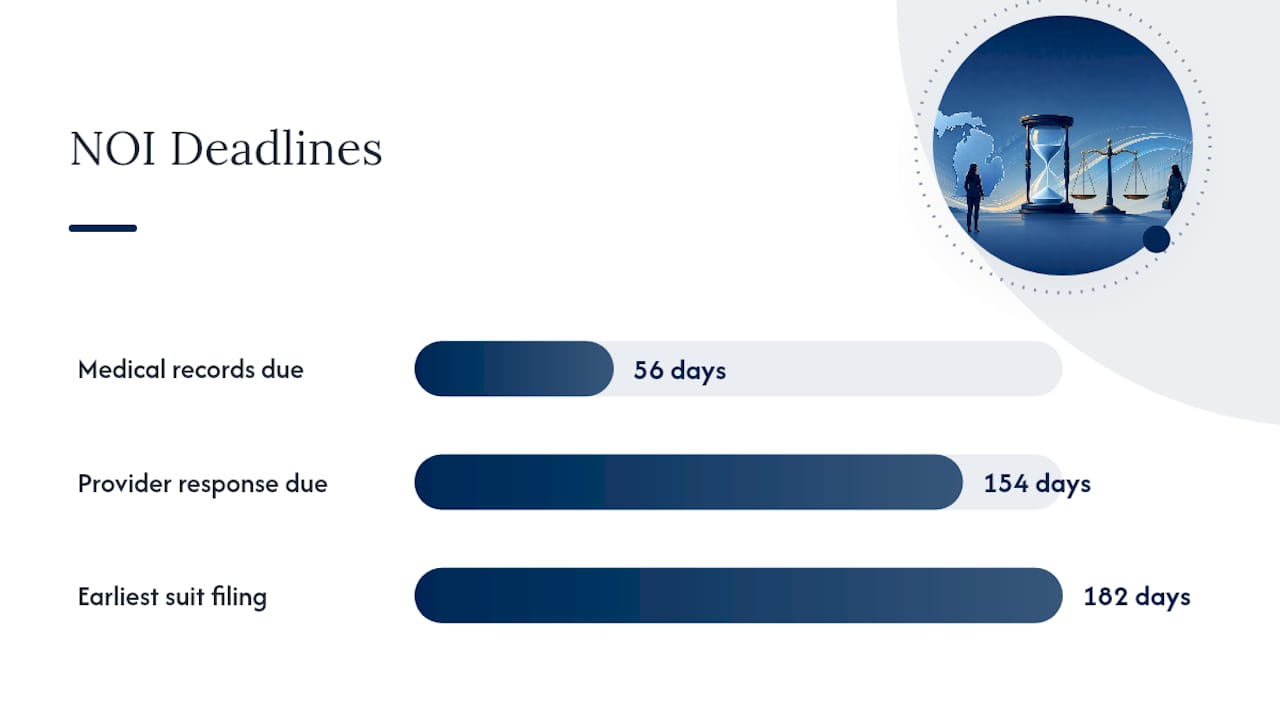
The 182-day period isn’t just a waiting room. It’s a structured window meant to encourage early resolution. Once a provider receives the notice, MCL 600.2912b obligates them to grant access to relevant medical records within 56 days and to provide a written response, admitting or denying the claim, within 154 days of receiving the notice. If the provider flatly refuses to settle before the 154 days run out, the plaintiff may sometimes file suit earlier than the full 182 days would otherwise allow.
| Milestone | Deadline After NOI Is Served |
|---|---|
| Provider must grant medical record access | Within 56 days |
| Provider must issue written response to claim | Within 154 days |
| Earliest date plaintiff may typically file suit | 182 days (or sooner if provider formally refuses to settle) |
| Prohibition on repeat notices for same claim | No tacking of successive 182-day periods |
That last row matters more than it looks. The statute expressly bars “tacking,” meaning a plaintiff can’t send a second NOI for the same claim just to buy more time. One notice period applies, and once it starts, the deadlines inside it move forward regardless of how the case develops. The Michigan courts’ benchbook on medical malpractice confirms the NOI operates as a strict prerequisite to commencing suit, not a suggestion.
- Send the NOI to every individual provider and facility you may sue, not just the primary physician.
- Keep proof of mailing; courts have dismissed cases over disputes about whether notice was properly served.
- Track the 182 days by calendar date, not by “about six months,” since Michigan courts count these deadlines precisely.
What the Affidavit of Merit Requires and Who Can Sign It
A notice of intent gets you to the courthouse door. The affidavit of merit gets you through it. MCL 600.2912d requires that a malpractice complaint be accompanied by an affidavit from a health professional who meets specific qualification standards, typically someone practicing in the same specialty as the defendant. This expert must attest that the applicable standard of care was breached and that the breach caused the plaintiff’s injury. Without it, the complaint is procedurally defective, and courts have dismissed otherwise strong cases for this reason alone.
Timing here is unforgiving. Because the affidavit has to reflect a genuine expert opinion, plaintiffs and their attorneys need full access to medical records well before the 182-day notice period ends. Waiting until the last weeks of the NOI window to start expert screening is one of the most common ways a strong malpractice claim collapses before it ever reaches a judge.
Pro Tip: Order certified copies of every relevant medical record the day you decide to pursue a claim, not the day you hire an attorney. Providers have 56 days to grant access under MCL 600.2912b, and that clock is often the tightest bottleneck in the entire pre-suit process.
Michigan law does build in some flexibility. If a defendant refuses reasonable access to records, plaintiffs can seek judicial intervention, and the statute allows for a 91-day extension to file the affidavit in certain documented situations. That extension isn’t automatic. It requires an active request and a record showing why the delay was necessary, which is exactly the kind of procedural detail an experienced malpractice attorney Michigan plaintiffs consult tends to catch before it becomes a crisis.
How Filing and the NOI Toll the Statute of Limitations
Tolling is where Michigan malpractice statute of limitations rules get genuinely confusing, and it’s also where cases get won or lost on timing alone. Under MCL 600.5856, filing and properly serving a complaint tolls, or pauses, the limitations period. Separately, sending a valid NOI also tolls the clock for a defined period tied to the notice’s own timeline. These two tolling mechanisms interact, and getting the sequence wrong can either shorten your filing window unexpectedly or, in rare cases, cause a court to treat a complaint as premature.
The Michigan Supreme Court addressed part of this confusion directly in Ottgen v. Katranji/22-23/ottgen-op.pdf), holding that ordinary tolling rules apply to malpractice actions and that a timely-served complaint tolls the statute even before an affidavit of merit is filed. In other words, filing the affidavit of merit is not itself the trigger for tolling; serving the complaint is. That distinction matters for plaintiffs racing a deadline, because it means the affidavit can sometimes be perfected slightly after the complaint is filed without losing the tolling benefit, so long as the complaint itself was timely and properly served.
Haksluoto v. Mt. Clemens Regional Med Ctr tackled a different piece of the puzzle: how courts count fractional days when a plaintiff files an NOI on or near the last day of the limitations period. The Court of Appeals confirmed that Michigan courts count the day the NOI is filed as part of the calculation, which can matter enormously when only a handful of days separate a claim from expiration.
Fractional-day counting isn’t academic. A plaintiff who files a notice of intent on what they believe is the final day of a two-year window may find, after the 182-day tolling period runs, that only a few days remain to file suit rather than the weeks they expected.
Here’s how the math typically works in practice:
- The malpractice occurs on a specific date, starting the two-year clock under MCL 600.5805(8).
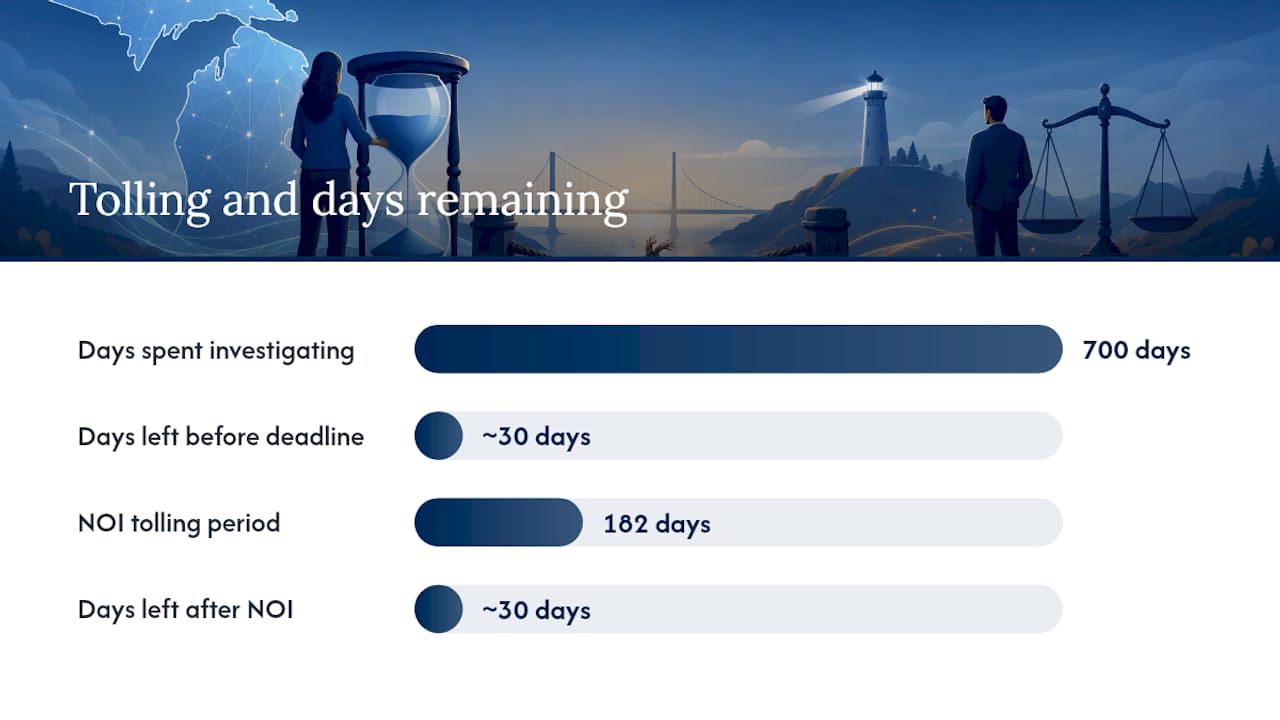
- The plaintiff uses 700 days investigating and gathering records, leaving roughly 30 days before the two-year deadline expires.
- The plaintiff files the NOI on that last available day, which tolls the limitations period under MCL 600.2912b.
- The 182-day notice period runs its course, and the tolled time resumes counting once that period ends.
- The plaintiff is left with approximately the same 30 days remaining after the NOI period closes, not a fresh two-year window.
That fifth step is where cases fall apart. Plaintiffs sometimes assume the NOI resets their clock. It doesn’t. It pauses it, and the days left are exactly the days you had when you sent the notice.
Michigan’s Caps on Noneconomic Damages
Even a well-preserved claim runs into another statutory limit at the compensation stage. MCL 600.1483 caps noneconomic damages, meaning compensation for pain, suffering, and similar harm, in Michigan medical malpractice cases. The statute sets a standard cap on noneconomic damages and a higher cap for specific categories of severe injury. These caps adjust annually based on the consumer price index, as calculated by the state treasurer.
The elevated cap generally applies to injuries such as permanent loss of a limb or organ function, permanent cognitive impairment preventing independent living, or permanent loss of the ability to procreate. These aren’t automatic; a plaintiff has to establish that the injury fits the statutory category, which often becomes a contested issue at trial.
Because these caps apply only to noneconomic damages, they don’t limit compensation for medical bills, lost wages, or future care costs. That distinction shapes how a malpractice claim timeframe in Michigan gets negotiated. Attorneys often build settlement strategy around documenting economic losses thoroughly, since those figures aren’t subject to the same statutory ceiling.
What Happens If You Miss a Deadline
Missing a Michigan malpractice deadline doesn’t always mean the same outcome, but none of the outcomes are good. If you file a lawsuit before the 182-day notice period has run, and time still remains on your underlying limitations period, courts typically dismiss the case without prejudice, meaning you can refile once the notice period actually concludes. If, however, the two-year statute of limitations or six-year repose period has already expired by the time the defect is caught, the dismissal is usually with prejudice, ending the claim permanently.
- Filing suit too early under the NOI rules generally results in dismissal without prejudice if time remains.
- Filing after the limitations period or repose period expires generally results in dismissal with prejudice.
- Fraudulent concealment by a provider can, in narrow circumstances, extend the filing window.
- Minors and individuals under legal incapacity receive tolling protections that can extend otherwise-expired deadlines.
- The burden of proving any exception applies falls on the plaintiff, not the defense.
Pro Tip: If you suspect a filing deadline has already passed or is about to, don’t wait for certainty. Preserve every medical record and communication you have immediately, and get a malpractice attorney Michigan courts recognize to evaluate whether any tolling exception, such as minority, incapacity, or fraudulent concealment, might still apply.
These exceptions are narrow by design. Courts don’t grant them liberally, and simply not knowing about a deadline is never itself an exception. That’s precisely why understanding how to file malpractice in Michigan correctly, and early, matters more than almost any other factor in the case.
Preserving Your Claim: A Practical Checklist
If you believe you have a Michigan malpractice claim, the sequence you follow in the first weeks often determines whether the case survives procedurally, regardless of how strong the underlying medical facts are.
- Request complete medical records from every provider involved as soon as possible.
- Calculate your accrual date and count forward to identify your two-year deadline and six-year repose ceiling.
- Draft and serve a compliant notice of intent naming every potential defendant, with proof of mailing retained.
- Begin expert screening immediately so an affidavit of merit can be prepared within the statutory window.
- Track the 56-day record access deadline and 154-day provider response deadline once the NOI is served.
- Document any provider refusal to grant record access, since that can support a request for procedural extensions.
Pro Tip: The single biggest factor separating claims that survive pre-suit procedure from those that don’t is how fast records get collected. Providers have 56 days to grant access under MCL 600.2912b, but that window is often the tightest bottleneck in the entire process, and delays here cascade into every later deadline.
On a contingency basis, a firm handling this kind of claim typically starts with a case evaluation, moves into medical record collection and expert screening, then drafts and serves the notice of intent while managing every downstream deadline through the 182-day period and into litigation if the case doesn’t resolve. That structure exists because the Michigan malpractice lawsuit process punishes disorganization more severely than almost any other area of personal injury law.
What We See Go Wrong in These Cases
The single most common mistake in Michigan malpractice claims isn’t a weak medical case. It’s delay, specifically, delay in requesting records and delay in assuming the discovery rule will rescue a claim that’s already past the two-year mark. Plaintiffs frequently believe that because they only recently connected their symptoms to a prior treatment, they automatically have six fresh months to act. That’s only true if they can prove they couldn’t reasonably have discovered the harm sooner, and that burden trips up more valid claims than any weakness in the medical evidence itself.
Realistic timelines matter here too. Initial case evaluation and record review typically take several weeks. Securing a qualified expert to review the file and prepare a preliminary opinion, the foundation for the eventual affidavit of merit, often takes additional time, particularly for specialties where qualified experts are in short supply. Settlement discussions frequently intensify during the back half of the 182-day notice period, once a provider’s insurer has reviewed the notice and weighed the cost of litigation against early resolution. Cases that don’t resolve during that window typically proceed toward formal litigation, with trial readiness measured in months to a year or more depending on court schedules and the complexity of expert testimony required.
Get Help Preserving Your Michigan Malpractice Claim
2keller gives Michigan plaintiffs something a solo filing attempt can’t: a team that tracks every statutory deadline in this article simultaneously, from the 182-day notice period down to the 56-day record access window, so a single missed date doesn’t end a valid claim.

Malpractice cases are unforgiving on procedure even when the medical facts are clear cut, and that’s exactly where a contingency-based legal team earns its role. 2keller reviews the case, orders and analyzes medical records, screens qualified experts for the affidavit of merit, and drafts and serves the notice of intent, all while managing the 182-day clock so nothing lapses. Because representation is contingency-based, there’s no fee unless the firm recovers compensation for you. If you’re trying to understand how the medical experts involved in a claim actually support it, read about the role of a physiatrist in injury claims before your consultation. If you suspect you have a claim, or you’re unsure whether your deadline has already passed, request a free case review with 2keller today to find out where you stand.
Primary Sources for Michigan Malpractice Law
- MCL 600.5805(8), the general two-year statute of limitations for malpractice actions.
- MCL 600.5838a, covering accrual, the six-month discovery rule, and the six-year statute of repose.
- MCL 600.2912b, setting the 182-day notice of intent requirement and provider response timelines.
- MCL 600.2912d, establishing the affidavit-of-merit requirement and expert qualifications.
- MCL 600.1483, imposing caps on noneconomic damages in malpractice cases.
- Haksluoto v. Mt. Clemens Regional Medical Center, the Court of Appeals decision on fractional-day counting near filing deadlines.
- The Michigan courts’ medical malpractice benchbook, summarizing accrual, tolling, and NOI prerequisites for practitioners.
This article provides general information about Michigan malpractice law and is not a substitute for advice from a licensed attorney about your specific situation. Deadlines and statutory figures can change, so confirm current requirements with a qualified Michigan malpractice attorney before relying on any timeline discussed here.
Sources
Recommended
- Wrongful Death in Michigan: What Families Should Know – Keller & Keller Injury Lawyers
- Michigan No-Fault Law Order of Priority: Who Pays My bills? – Keller & Keller
- Michigan’s Complex No-Fault Law – Keller & Keller
- How Michigan’s Proposed “Open and Obvious” Bills Would Harm Injury Victims – Keller & Keller