
A medical records request after an accident is your legal right under HIPAA and applicable state laws, and it is one of the most powerful tools you have for supporting an insurance claim or personal injury lawsuit. Without a complete, well-organized medical file, insurers can deny or minimize what you are owed. This guide explains exactly which records to gather, how to request them correctly, how to handle delays, and how to use your documentation to build the strongest possible claim.
Which medical records should you request after a car accident?
A complete medical evidence file for an accident claim includes far more than a simple discharge summary. Many people request only the hospital report and miss documents that directly affect claim value.
The full list of records you need includes:
- Emergency department and triage notes: These capture your initial presentation, vital signs, and the treating physician’s first assessment of your injuries.
- Ambulance and EMS run sheets: Paramedic observations made at the scene often document pain levels and injury descriptions that later records may not repeat.
- Operative and surgical reports: If you had any procedure, the surgical report details the extent of injury and the medical necessity of intervention.
- Physical therapy and rehabilitation records: These show the ongoing impact of your injuries and the treatment required to recover.
- All imaging files, including original X-rays and MRIs: Request the actual image files, not just the radiologist’s written interpretation. Attorneys and independent experts need the originals.
- Itemized billing statements: Ask for statements that separate the total charge, any insurance adjustments, and the amount actually billed to you. This breakdown is critical for calculating economic damages.
- Specialist consult notes and follow-up records: Every physician who evaluated or treated you hold a separate file that must be requested individually.
Pro Tip: Ask each provider for records related to “all treatment dates” rather than a single visit. Providers sometimes interpret narrow date ranges literally and omit follow-up records.
Missing records, especially imaging files or itemized bills, can significantly weaken your insurance claim. Gathering everything upfront is far easier than chasing documents later under legal pressure.
How to properly submit a medical records request after an accident
The process for requesting health records is governed by HIPAA at the federal level, with some states imposing stricter rules. California, for example, requires providers to respond within 15 days, which is shorter than HIPAA’s standard timeline. Knowing the process protects your rights and speeds up delivery.
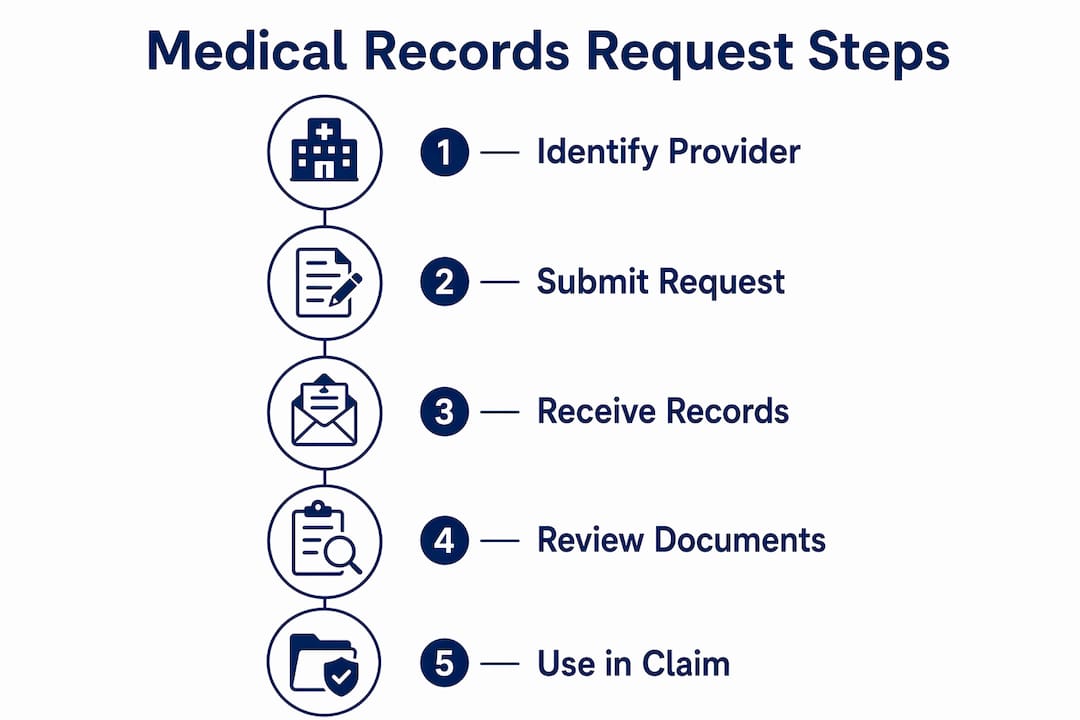
Follow these steps for every provider involved in your care:
- Prepare a written request. Include your full legal name, date of birth, the date of the accident, and the specific treatment dates you are requesting. Vague requests produce incomplete files.
- Submit to each provider separately. Medical records are siloed across hospitals, ER physician groups, imaging centers, and EMS agencies. One request to the hospital does not capture the radiologist’s file or the ambulance run sheet.
- Use precise language. Phrases like “certified complete medical record” and “HIPAA records request” speed up processing and reduce the chance of receiving a partial file. Ambiguous requests like “I need my records” routinely produce incomplete results.
- Direct your request to the Health Information Management (HIM) department. This is the correct department at most hospitals and large practices. Sending requests to a general inbox or front desk often causes delays.
- Document every submission. Send requests via certified mail with return receipt, save fax confirmation pages, or screenshot your patient portal submission. This establishes the legal start date for the provider’s response deadline.
- Know your timeline. Federal HIPAA rules require providers to respond within 30 days. Providers may take one additional 30-day extension if they notify you in writing. Plan your claim timeline around this window.
- Ask about fees upfront. HIPAA permits providers to charge a reasonable, cost-based fee for copying records. State laws often cap these fees. Request an itemized fee estimate before submitting a large records request to avoid unexpected costs.
Pro Tip: Request electronic copies whenever possible. They arrive faster, cost less, and are easier to share with attorneys and insurers.

Common challenges when obtaining a complete medical record package
The biggest obstacle in the medical file retrieval process is not provider refusal. It is fragmentation. Your records exist across multiple separate systems, and each requires its own request.
Common problems and how to address them:
- Incomplete files from vague requests. Specifying exact document types, such as “all imaging studies including original DICOM files,” prevents providers from sending only a summary.
- Delays beyond legal deadlines. If a provider misses the HIPAA deadline without notifying you in writing, send a follow-up letter citing the specific deadline and requesting an immediate response. Keep a copy of every communication.
- Denied or incomplete requests. If a provider denies your request or sends an obviously partial file, you have the right to file a complaint with the U.S. Department of Health and Human Services Office for Civil Rights. An attorney can also issue a subpoena for records in active litigation.
- Tracking correspondence. Maintain a log that records the date of each request, the method of delivery, and the date you received a response. This log becomes evidence if you need to escalate.
Requesting your own records directly saves time and money compared to letting an insurance company request them on your behalf. When you control the request, you control what gets shared and with whom. Insurers who gather records independently may access information that is irrelevant to your claim but harmful to your case.
Insurance adjusters exploit gaps in documentation to deny or minimize claims. A missing ambulance run sheet or an absent imaging file gives an adjuster grounds to argue that your injury was not as serious as claimed. Completeness is not optional. It is the foundation of a credible claim.
How to use your medical records in insurance claims and legal proceedings
Personal injury medical records serve one primary legal function: establishing a clear causal link between the accident and your injuries. Without that link, an insurer has no obligation to pay.
Here is how to put your records to work:
- Request a written causation letter from your treating physician. This letter states, in medical terms, that your injuries were caused by the accident. Request this letter at a follow-up appointment, not by phone or portal message. Providers often charge a separate professional fee for this document, but it is worth every dollar.
- Be transparent with your doctors about your symptoms and pre-existing conditions. Being transparent with your providers about pre-accident conditions ensures your records accurately reflect what changed after the collision. Adjusters look for inconsistencies between your reported symptoms and your documented history.
- Control what you share and with whom. Share records with your attorney before sending anything to an insurer. Your attorney can identify records that are irrelevant to the claim and potentially damaging if disclosed unnecessarily.
- Avoid gaps in your treatment timeline. Missed appointments and long gaps between visits give insurers grounds to argue that your injuries were not serious enough to require consistent care.
- Use itemized billing statements to support damage valuation. A statement that separates the billed amount, insurance adjustments, and your out-of-pocket costs gives attorneys and courts a clear picture of your actual economic loss.
If you feel sore after your accident but are unsure how to describe your symptoms to a doctor, discussing your injuries accurately from the first visit protects the integrity of your records.
Key Takeaways
A complete, properly requested medical record package is the single most important document set you can build after an accident to protect your insurance claim and legal rights.
| Point | Details |
|---|---|
| Request all record types | Include ER notes, EMS run sheets, imaging files, surgical reports, therapy records, and itemized bills. |
| Submit separate requests | Each provider, including imaging centers and EMS agencies, holds its own file and requires its own written request. |
| Use precise language | Phrases like “certified complete medical record” reduce incomplete responses and speed up delivery. |
| Document every submission | Certified mail receipts and portal confirmations establish the legal start date for HIPAA response deadlines. |
| Control your own records | Requesting records yourself keeps you in control of what insurers see and prevents harmful disclosures. |
What I’ve learned about medical records from years of injury cases
After working alongside accident victims through the claims process, the pattern I see most often is this: people wait. They assume the hospital will send everything automatically, or that their insurer will handle it. Neither assumption is correct.
The records that matter most, the ambulance run sheet, the radiologist’s original imaging files, the itemized bill showing what was actually charged versus what insurance paid, are almost never delivered without a specific, written request. I have seen strong cases weakened not by the facts of the accident, but by a missing document that no one thought to ask for.
The second mistake I see is timing. Waiting months to request records creates problems. Providers archive files, staff turns over, and some records have retention limits that vary by state. The sooner you submit your requests, the better your chances of receiving a complete file.
The third mistake is letting the insurance company drive the process. When an adjuster requests your records directly, they may access information that has nothing to do with your accident but can still be used to dispute your claim. Requesting your own records and sharing them selectively, with your attorney’s guidance, keeps you in control of your own case.
— Adam
How 2keller can help you build a strong injury claim
Gathering and organizing medical documentation after a serious accident is time-consuming and legally complex. 2keller’s personal injury attorneys in Indiana, Michigan, and New Mexico handle the records request process for clients, including identifying every provider, submitting properly worded requests, tracking deadlines, and escalating when providers delay or deny access.

2keller also works with treating physicians to obtain causation letters and reviews all documentation before it is shared with insurers. If your claim has been delayed or denied because of incomplete records, our team can step in and rebuild your file. Contact 2keller for a free consultation to discuss your accident and what your medical documentation can do for your case.
FAQ
What is a medical records request after an accident?
A medical records request after an accident is a formal-written request submitted to each healthcare provider who treated you, asking for copies of all documentation related to your care. These records are used to support insurance claims and personal injury lawsuits.
How long does a provider have to respond to my records request?
Federal HIPAA rules require providers to respond within 30 days. Providers may take one additional 30-day extension if they notify you in writing. Some states, like California, impose shorter deadlines of 15 days.
Can a provider charge me for my medical records?
Yes. HIPAA permits providers to charge a reasonable, cost-based fee for copying records. State laws often cap these fees. Request an itemized fee estimate before submitting a large request to avoid unexpected costs.
What should I do if a provider sends incomplete records?
Send a follow-up written request specifying the missing documents by name. If the provider continues to withhold records, you can file a complaint with the U.S. Department of Health and Human Services Office for Civil Rights, or an attorney can issue a subpoena.
Should I let my insurance company request my medical records?
Requesting your own records gives you control over what is shared with insurers. When insurers request records independently, they may access information unrelated to your claim that could be used against you. Work with an attorney to manage disclosure.